Fill Our Hearts with Power

I really do intend to update the Writing Shed weekly. But sometimes, events seem to leave me dumbstruck. Well, not so much dumbstruck, as waiting for the light bulb to click on, shed light on the dark corners that harbor the missing pieces of the puzzle I am trying to put together.

My small personal world and the global world intersected last week. There was the fiftieth anniversary of Martin Luther King’s “I have a Dream” speech. There was a comment in a blog by a colleague that claimed we really can’t ever get into another’s shoes, can’t really imagine what their lives are like. And then, the drumbeat for action in Syria, followed by Obama stepping back, deferring to our Constitution, defining this moment as one that has global as well as national interests.

In many ways for me, the decade of the Sixties was about tossing our Pick-Up Sticks into the air and waiting for them to come down. The music, the liberation from the conformity of the Fifties, the march into a future that attempted to shed the past, were a part of that era for me. But what really defined that period for me was the Civil Rights movement. That August 1963 March on Washington was a defining moment.

In the shadow of Lincoln, a quarter of mile from Jefferson, King took the idea, the dream, of America to the next level. Jefferson planted the seed. Lincoln cleared the blight of slavery, and then King called on us to partake in the bounty promised by Jefferson’s ideas. He claimed entitlement to the ideals promised by Jefferson’s declaration that all men are created equal.

Some pointed out that there were no women speaking on the day. There weren’t. But fifty years later, it was his youngest daughter who delivered the clarion call, the words that ended with bells rung throughout the country in the name of human rights.

The Civil Rights movement, the clarion call of King’s dream have rippled over the years. The women’s movement was about civil rights. The disability movement was about civil rights. The LGBT movement is about civil rights. It shone a light so that those who lived in darkness and shadow could claim their right to a place at the table.

Clearly, things aren’t perfect. My colleague’s blog told of her experience as a female attorney in the late Eighties and early Nineties. Fifteen years younger than I, hers was the generation of women who began changing in large numbers the landscape of the playing field that had typically been an exclusive male club. Women, it seemed had arrived.

The message she received when she joined the firm was clear: be one of the boys or be the outsider, and by the way, you will never be one of the boys. Her colleagues in the firm, she said, could not imagine her life, what life was like in her shoes, because we are not capable of really doing that.

I think she let them off the hook. I think they chose, consciously or unconsciously, to refuse to see the world from her perspective. They had too much to lose—their position of privilege based solely on their gender and race.

The biggest flaw in the early women’s movement was the assumption that we needed to be seated at the men’s table—that power came from emulating them. I think that is changing. I suspect that to the current generation (the Millenials, if you will), this is not much of an issue. I think they see each other as equals in a way that none of us dreamed possible fifty, or even twenty, years ago.

The drumbeat for action in Syria left me with such mixed feelings. The horror that is happening is Syria seems to me to call for some kind of action. But what is the proper action?

Then President Obama took a step back. He called on the American people to respond to the atrocities. And, just as important, he called for the world community to take a stand.

To some, this was a sign of weakness. I think not. I think it is a sign that he has a deep understanding of the world we live in, and of power.

We have perhaps the most powerful military in all of human history. We have the might to enforce might makes right. Obama is probably correct that he has the authority, the power, to order military strikes without the consent of Congress or other countries.

But that is too much power to put in the hands of one person. I think that is what Obama understood, and why he took the step back. That is not weakness. That is strength.

I don’t want to idealize Obama. I could be wrong. We’ll see. I’m hoping that by forcing Congress to be accountable, he can disrupt the dysfunction that has consumed it and that maybe, just maybe, we can take that next step to realizing the dream.

In the film The Mission the priest, portrayed by Jeremy Irons, explains to Robert deNiro why he won’t take up arms. Perhaps might makes right he says. Maybe so. Maybe so. But if might makes right, there is no room for love in the world. I cannot live in such a world, he says.

I hope we are taking this moment in history to make room for love in the world—to fill our hearts with power—as we move forward as a country and as a world community.

Huzzah to Next Week

My grandmother was nineteen when she got married, thirty when she got the right to vote. Three years later, my mother was born. Twenty-six years later, I came into the world.

By the time I turned twenty, women still could not get a credit card without their husband’s permission. I’m guessing that single women simply couldn’t establish credit on their own. My friend Sally, a professor at UCLA, was running downstairs between classes to use the Women’s bathroom—the Faculty bathroom on the floor where she taught classes had urinals. Faculty bathrooms with urinals is a not so subtle message.

A woman had to prove she was crazy to terminate a pregnancy. Newspapers still divided help wanted ads into Help Wanted Men and Help Wanted Women. A listing for a college educated, bi-lingual secretary paid less than a janitor. The secretary was filed under Help Wanted Women; the janitor under Help Wanted Men.The accepted wisdom was that men would be supporting a family, so deserved more pay. It was also accepted wisdom that hiring a single mother as a secretary was a smart move because she would be more compliant—she had a family to support and so would be afraid to talk back. Temporary employment agencies carried names like Kelly Girl and American Girl.

I was 13 when Martin Luther King, Jr., gave his “I Have a Dream Speech.” I can’t honestly say what I remember about it, other than a sense of hope for the future and belief that my country valued the dignity at the base of being human. I also remember the cover of Life magazine, just a few months before—Myrlie Evers comforting her young son, weeping for his slain father.

The years that followed the speech were gruesome. Civil rights workers—black and white, men and women—were murdered for trying to register blacks to vote, their murderers set free by juries of their peers. Fire hoses were aimed at peaceful marchers; attack dogs set upon them. The North proved no better with riots in Watts and Detroit, hate-filled marches in Chicago.

It seemed by the next decade that some things had been settled: women had a right to choose; the right to vote was sacred, as sacred as the American flag; a precedent had been established that ensured human rights, regardless of color or gender, a precedent that laid the groundwork for ensuring rights regardless of sexual orientation. It was a precedent that human rights were more important than States’ rights.

To say that the events of the last few years have been seriously south of disheartening is an understatement. Given that it is a minority of people who are driving the effort to turn back the clock to an hour fraught with such brutality, it is particularly unnerving to watch events unfold.

Two important anniversaries will happen this week: the passage of the 19th Amendment, the one that enshrined my right to vote, and the March on Washington, when Martin Luther King, Jr., gave us his dream of what America can be.

His dream, his notion, of America is the same as mine. Our founders set in motion an idea, recorded in a Constitution, that enshrined a commitment to honoring the inherent dignity in a person. Back then, it was primarily applied to white, property-owning men. But an idea like that cannot be contained. It can only grow.

That was what was important about the Sixties to me. By the time the decade came to an end, we were just 25 years past a war that had horrified us with the Holocaust. During that same war, black American soldiers had to ride in cars behind German prisoners of war—those who had fought for the country were second class to those who we were fighting against.

Once the genie is out of the bottle, you can’t put him back.

Change does not come easily to humans. But the nature of life is change. Snakes shed their skin because they keep growing—imagine what would happen if they didn’t—or couldn’t—shed their skin.

Despite the attempt to turn back the hour to a brutal, unjust time, I am hopeful. I am hopeful because we cannot thrive as a nation, as a people, if we do not adapt to change. The generation coming up has already shed the skin of prejudices to which older generations thought they were entitled. If older generations won’t shed that skin—well, imagine what would happen to a snake that refused to shed the skin it had outgrown.

Huzzah for this coming week of anniversaries. Let us celebrate their shedding light into dark corners. Let us fill our hearts with the power of human dignity these anniversaries commemorate to shatter the mean-spirited enshrinement of power by those who refuse to change.

What in the World is Goin’ On?

“What in the world is going on?” my grandmother asked my grandfather as he crossed the yard. She was hanging the laundry to dry, my two oldest uncles playing nearby, my aunt in the cradle by her side.

Beyond her yard, sirens were blaring. Fireworks were booming. People were whooping and hollering.

“Put down your laundry and put on your hat,” he said. “We’re going to town. The war is over. The boys are coming home.”

It was November 1918.

That image has stuck with me 34 years after my grandmother told me that story: my grandfather striding across the yard. My grandmother, surrounded by domesticity, wondering, “What in the world is going on?”

It was a common expression back then: What in the world is the matter with you? What in the world am I going to do with you? What in the world am I going to do with this fallen cake?

But, it also told a piece of a story. I think the story went beyond my family, but it’s not always easy to tell how much is cultural and how much is familial.

My grandmother was born in 1889 in Kansas. When she was five, her family moved to Lawton, Oklahoma. “First there was nothin’. Then there was tents,” she explained to me. This was in 1979. I was recording her life story—it was to be a surprise for her 90th birthday.

She had wanted to be a telegrapher, she said. But she was nineteen, there were eight others at home, so she thought it best she got married.

And so she did. And so started a story about women and their choices: you could either be out in the world, or in the home, you couldn’t do both. A woman out in the world was a threat to the domestic scene—you might be more interesting to the man, keep him from coming home at night. The woman out in the world was barred from things domestic; to the woman in the home, she was as useless as the man she served when it came to things of the hearth and home persuasion. More man than woman.

Was that the story or is that how I interpreted the story? I don’t know. In retrospect, I think that storyline resulted from my grandfather’s philandering ways—an assault on my grandmother’s quest for domestic perfection and satisfaction.

At any rate, I have spent a good amount of time trying to reconcile my yearnings to be both a woman in the world and a woman in the home. It took me years to free the creativity that expresses itself in cooking, creating an inviting home, nesting—even cleaning (without the obsession). I chose a stealthy path of woman in the world. It wasn’t a career path, more like a quest. I was careful not to tread on the territory held by my grandmother, a territory that intimated my mother into stealthy submission.

I ate lunch at a bakery on Tuesday. This wasn’t a hippy-dippy bakery, my friend told me. It was more like the way my grandmother baked, buttery and sweetness. The aroma as we stepped into the shop confirmed it.

A woman named Betty (my mother’s name) invited us to sit with her. She was 83, born and raised on a dairy farm in Sequim, my new hometown, milked cows every day when she was growing up.

We got to talking about pie.

“Do you use lard or butter for your crust?” I asked. It is the closest thing I had to an intelligent question about the subject of making pie crust. I am totally intimated by pie crust. It is as mysterious to me as knitting.

“Half lard, half butter,” she said. “It’s all about not overworking it,” she said.

I’ve heard that before. Don’t overwork it. But as far as I can tell, you can’t tell that you’ve overworked it until its overworked. It’s a sensory thing—the touch and feel that comes with care and commitment to creating.

I find myself these days, not so much ignoring what’s going on in the world, as wanting a retreat from it from time to time—having time for and to reflect on things that are of what I have come to define as home. A friend’s father recently died at home. She called on her friend to be with her and her father during those final fours, that most intimate of time.

It is the intimacy of home, I think, that I have begun to embrace. I’m learning to bring all that I learned from being out in the world into the intimacy of my home. I think I am dispelling the curse and sentence domesticity was to the women in my family.

I wonder what my grandmother would think of Twitter. I find it baffling, wonder how you know when to shut it down, take a break from it. I think I tweeted once. But for her, who wanted to be the receiver and sender of news from the world, maybe she would have embraced it, setting down her knitting needles from time to time to tweet and respond.

“I’ve buried three husbands,” Betty, our lunch companion told us. “I think they thought the only way to get away from me was to die.” She was the very definition of 80 is the new 60. Lonely and sad to be a widow, somewhat baffled by it, but ready and willing to be vibrant and out in the world.

“I think you wore them out,” I said.

She smiled. “That’s how I’m going to look at it.”

I’d like to think that my years of working with words—the way I put myself out into the world—has given me the touch and feel for texture that her years of working with pie crust gave her. I do plan on trying my hand at making pie crust.

_______________________________________
Knitting update. I am still unraveling.

The Yellow Jacket in Sequim

deckSitting here on my deck in Sequim, Washington. Birds calling. Wind rustling the trees. In the distance, the sound of children playing. I feel like I am at summer camp.

I’m stepping outside my writing shed to write this morning. It’s more of writing shedish right now. I’ve cordoned off a section of the workshop building in the property we have leased for our initial entry into Sequim.

Outside the writing shedish

Outside the writing shedish

A yellow jacket that had managed to find its way into the building flung itself over and over into the window I sit in front of, seeking a way out. I had left the door open to my writing shedish, but the yellow jacket did not seem to find it—or even seek it out. I suspect it was fixated on its exit strategy—a closed window that offered a false promise.

Lesson learned from yellow jacket: when our efforts are foiled, look for other possibilities.

We have been here a little over a week now. I don’t know whether it’s the air, the spirit of the Northwest, the decision we made to change, or a combination of all of the above, but last Sunday, as we drove along Sequim Bay, it hit me: possibilities. They have grown exponentially since we landed here.

It’s a clean slate. We brought lots of boxes, but left behind baggage we no longer needed—the ghosts of people we loved, whose lives ended before we could fix what was left unfinished. Unfinished for us.

That’s the thing with life. It’s finite. But relationships are infinite. They continue in us. It’s up to us to make of them what we will—take what is ours and leave what was theirs to those who have finished living. Not an easy thing to do. Some love is unrequited for eternity for us. It’s the imperfection in the tapestry that lets life through.

Perhaps that is maturity. Accepting the love that was expressed, mourning for that that can never be.

I started this blog to change my story, to find the story that was mine, not one that was given to me. Our move to Sequim is the blank page in the story I am discovering.

Our front yard

Our front yard

We are leasing for nine months. It feels like a vacation home. Or more, a retreat. For me, a writing retreat. Instead of searching for community, my task is my writing.

Beans and Meatballs and the Pink Stuff is my current project. It’s a personal narrative about me and three women who had an impact on me: my mother, Sally Binford, and Jeanette Harris. All were born in the first quarter of the twentieth century: Jeanette, three years before women had the right to vote; my mother and Sally entered the world when that right was four years old.

All of us, in some way, were taught that, like the yellow jacket, the window we saw out of was our only possibility.

I’ll know more of what to say about that as the story unfolds.

When Life Gives You Lemons

Be grateful. Be very grateful.

lemon tree 1The first night we moved to our home in Livermore, I asked Tom if he would mind getting me a lemon. He looked perplexed. Did I really want him to go to the store to get just one lemon? And then it dawned on him what I meant—would he please pick one from the tree in our front yard.

I remember seeing an old movie, it might have been a silent one, where a hand reached out of a window to pick an orange hanging from the tree right next to the house. California. A paradise where oranges were in such abundance, you didn’t have to wait until Christmas to receive one in your stocking. All you had to do was reach out your window and one would jump into your hand.

That’s what that moment, the first night in Livermore, felt like to me.

It has been quite a journey, my return to Livermore. For Tom as well, I think. A paradise and a hell. The best and worst things in my life happened to me here—when I was a child, and then again when I returned.

I’ve asked myself, why? Why were there such extreme experiences and why did I return here?

On the surface it was family matters that drew us back. Tom’s dad and my mother were nearing the end of their lives. We came to care for them and ended up bearing witness to the waning of their lives.

There were many other losses we experienced while living here. Our cat Rug, Dominic’s wife. Doug’s wife. George. Marge. Ed.

There were triumphs. Tom’s commissions to write orchestral pieces. Fourth Street Studio and the Saturday Salons. Publishing five anthologies of the writing from people who came to the Salons. Productions of spoken words. Tom and I returned to acting. I directed my first two plays.

And then there were the painful obstacles. An arts community that was driven by the fear that there was not enough to go around—not enough talent, not enough acclaim, not enough enough. It created a competitive environment that was not based on striving for excellence, but rather battling over who would be in control, who would be the anointer.

I was always on the other side of this competition. Or rather, I was outside of it, never giving it credence, plugging along doing my work, producing events, publishing anthologies without waiting to be anointed.

I was surprised at the viciousness of the response to my successes. It became enervating, being the outsider. I sought community. It tweaked all my childish, festering wounds—all based on the question, why aren’t I acceptable? What’s wrong with me?

The big lesson for me in all of this was that being acceptable was not my story. My story is about being authentic. A writer’s voice, after all, must be authentic if she is to rise to Faulkner’s challenge issued in his Nobel prize speech: create from the materials of the human spirit, that which did not exist before.

We were told in our Hospice volunteer training that our job was to bear witness. We weren’t there to help, heal, cure, cheer up, or fix. We were there to bear witness to a life.

I like that: bearing witness.

I think that might be why I was called to return to a place that holds such extreme experiences for me. It was the opportunity to bear witness to my own life. To see the story I thought I was supposed to be living, and find the one that was mine. To begin to live that story.

When life gives you lemons, make lemonade the adage goes. But there is so much more you can do with lemons. Lemon meringue pie. Lemon sorbet. Lemon curd, Lemon juice in your salad dressing. Lemon juice squeezed over your fish, pork roast, roasted chicken. Lemon and honey and fresh ginger in hot water to soothe a sore throat. Lemon peel twisted, the oil from its rind circling the rim of the martini glass. Lemon zest added to—well to just about anything.

Life gives you the lemons. You get to decide what to do with them.

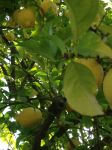
The trunk of Gene’s lemon tree is gnarly, the gnarl that comes with age. Lumps and bumps formed to heal wounds. A rod inserted to hold split halves together. Lemons dangling like ornaments from its branches and hidden like Easter eggs amidst the foliage on the ground.

Gene’s final words, spoken in the middle of the night, were to his hospital roommate. Words that seemed to come from an incoherent state but were in fact articulate. Words from a man who endured terrible disappointments, but whose heart never gave out.

“I’ve had a good life,” he said. “But I’m ready to leave. I think I’ll get in my car and get out of here.”

Of course it was he who planted that lemon tree. It’s his legacy. A gift that bears fruit year after year and reminds us that we can make of the fruit what we want.

That’s what I learned when I returned to my Livermore. Life gives us lemons. An abundance of them. And that’s a good thing.

An abundance of friends came to our farewell party, staying for our final howellelujha chorus, our howls reminding us that we are a pack of the heart. Tom and I felt well-loved. Felt we had made a difference—and I think that’s what we want in life—to feel like we make a difference.

Gene’s lemon tree stays behind. Bearing fruit. Bearing witness. Gene’s legacy. His gift to our world.

If life gives you lemons, be grateful. Be very grateful.lemons sun

Note: Our house has sold. This is the last post that I will write in my Writing Shed, the place that inspired the name for my blog. I will take this next week off. Next time I blog it will be from my new home, my next writing shed in the great Northwest.