Guilting the Lily

I would like to just walk away from this, but it sticks in my heart and mind, the charge that I am a bully. Look inside myself—anonymous, and one not-so -nonymous, commenters said to me. If they are saying I’m a bully and they know many, many people who agree, then it must be so. Their feelings are valid. (Okay, they also accuse me of a having a “chronic need” for validation and recognition, which I think is a bit ironic.)

I did look inside myself and couldn’t find the bully they described. But I found it hard to write a blog post. Nothing seemed to get through the fog. The more I told myself to let go, the harder it was to think of something else. It was kind of like when I was a kid on Christmas Eve and the grown ups told me that Santa wouldn’t come until I fell asleep—and then I tried to fall asleep.

I just couldn’t get the voices of the chorus out of my body, mind, heart, and psyche. I had no idea what to do with that energy.

So, I set on a quest to understand what it was I needed to let go of.

Betrayal? That was painful, but that healed.

Anger? As always, that one subsides with time.

The hope that things could have been different? Almost there.

And then, I found it, lurking in my genetic conditioning—what I need to let go of: guilt and shame. Guilt for believing that I am entitled to be recognized for my accomplishments and shame for voicing it.

I will readily admit that the most painful thing for me is when someone willfully doesn’t “hear” me.

I will also readily admit that not being heard is a deeply rooted wound for me. I believe that when that happens, I attempt again and again to be heard, increasing the desperation and then the volume, as if either will solve the problem. I become relentless in my attempt to be heard.

I suspect my relentlessness is what is being translated as bullying. It is perceived as hostility, but really, it’s anger. I would say that willfully not hearing someone is a hostile act—a passively hostile act. I suspect that the decision to willfully not hear is a defense mechanism, one that might not even be conscious. It’s probably reflexive.

But that’s the other person. The question for me is: why the relentless pursuit to be heard when it’s clear that the person either doesn’t have the ears that are capable of hearing or just doesn’t think it’s important to hear me.

There is that niggling voice inside me that preaches guilt: who am I to expect to be heard—it is after all, just me.

So, really, I end up yelling at my own guilt. It’s the most useless form of guilt ever created by humans—a guilt for which there is no way out, because there is no reason to feel guilty to begin with. It is our birthright to feel entitled to our own life.

If gilding the lily means giving something a deceptively attractive or improved appearance, then I think guilt over feeling entitled to one’s own life is “guilting the lily.”

I don’t think we need to do either with our lives.

In defense of my relentlessness, it was my relentless pursuit to have writing as an art integrated into Art Happens that got Storied Nights established. I continued pursuing that goal when other writers who wanted a venue for recognition of all forms of writing gave up. Tricky thing, it is, the strength that can also be your weakness.

Words and Music Move North

OLYMPUS DIGITAL CAMERAOur friends Holly and Richard Sears brought a bottle of homemade wine to our going away party. The label read, “Words and music moving north.”

We passed our one-year anniversary in Sequim last Saturday. We arrived on June 14, 2013.

As I read through the New York Times this morning, I noticed a new film with Liam Neeson. It opens in New York and Los Angeles this weekend. In my Bay Area days, I lamented when movies like this only opened in those two cities, but knew that it would open in a theater somewhere near me soon. Not so much up here.

Movies have always been a way for me to decompress, refresh, put whatever is mangling my foremind into my backmind so I can let my unconscious or the universe, whichever is the most appropriate, untangle the mess. I would sometimes see two or three movies a week. Maybe four.

So, the one thing that I sort of kinda’ miss about living here in a rural environment is movies. There’s a great theater in Port Townsend that shows “art” as well as first-run films. That’s a 45-minute trip, but well worth it. The theater itself is cool. I saw Chef there recently—on a particularly bad mind-mangled day when I needed chocolate. The movie was showing in the Twilight Room where they serve food and beverages of all persuasion. So I ordered a chocolate martini.

Great story. Great chocolate martini. Movie fix and chocolate fix all in one fell swoop.

The grandeur of the mountains, the deer roaming through my yard, and the ducks with their ducklings and geese with their goslings, all make me miss movies a little less. My mind seems to get mangled less.

ota buildingIn addition, there is the local theatre company, Olympic Theatre Arts. The Olympic Theatre Arts Center was one of the draws for us moving here. Built-out in an old church, it is an impressive facility for a town the size of Sequim (6,000 in town—probably 26,000 with the surrounding area). Light booth. Sound booth. Shop for building sets. Dressing room and green room. A hall, called the Gathering Hall where certain performances can be held. The main theater seats 165.

And then there is the talent. Good actors. Good directors. And, as I am learning, incredible talent for set design, light design, and costume design—all dedicated to telling the story. I’m currently the production manager for Sherlock Holmes: the Final Adventure. The costume designer in one of the early meetings, said she planned on few costume changes because she didn’t want the costumes to be the story. She wanted the costumes to help tell the story.

I never knew.

Tom and I have jumped in and are knee deep in the company. Our proposal for staging a reading of Twelfth Night, on Twelfth Night, was received with enthusiasm. We held it in the Gathering Hall, which was transformed into a Shakespeare-era gathering hall thanks to the imagination of Rosie von Engel. She is also the set designer and dresser for Sherlock. As with the costume designer, she does her research and insists on details that ring true to the era.

These people care about the production and the audience—they know what it takes to make the audience suspend its disbelief.

Tom is in Sherlock. He plays Watson. He also is writing music for an aria that is part of the story and incidental music for certain scenes and scene transitions, and is creating sound effects using the inside of the piano. Oh, my!

OLYMPUS DIGITAL CAMERAI had the privilege of directing and acting in Love, Loss, and What I Wore (by Nora and Delia Ephron, based on the book by Ilene Beckerman) in March and will be directing The Good Doctor, set to open in September. The Good Doctor is one of Neil Simon’s lesser-known plays. The company had considered Barefoot in the Park, but had trouble finding someone to direct it. I considered it, but thought the play and its humor seemed dated in 2014. So I dug around and found The Good Doctor. I liked it because I think Simon went out of his comfort zone to write this play—a series of 11 sketches—nine based on Chekov short stories and two Simon originals. Simon drew on his experience writing for Your Show of Shows to create comic sketches that could have been on 19th century Russian television—had Chekov had Sid Caeser—and televeision—to write for.

If that makes sense.

We also were able to get a series started called “An Unusual Evening in Sequim.” We stole the title from our early mentors, Cask and Mask. Well, they just called it an Unusual Evening—we added the Sequim part.

Our first one was a celebration of Shakespeare’s birthday. Local actors selected their favorite passages from Shakespeare to read to the audience and tell them why Shakespeare was so important to them. We did a rap version of “You Say It’s Your Birthday” spoken like Shakespeare, “Thou sayest’s thy birthday . . .” and served cake.

The audience has grown for each evening. At the May event, Local writers read stories about Sequim and the peninsula to help celebrate the Irrigation Festival. We started the evening with an interview with Joe Borden, who has worked on the festival for 19 years. Why do we have an irrigation festival? Because there would be no Sequim if “Crazy” Callen and his partners hadn’t figured out how to make water run uphill, Borden told us. It was a parched prairie before the irrigation ditches.

camiOur June event was something I had wanted to do for years. Tom has written music inspired by my writing and I have written pieces inspired by his music. My favorite “collaboration” was around Tom’s Music Box Rag. I wrote a poem titled “Tending the Garden of Shared Memories,” that reflects on a music box that might or might not have ever been, given to a little girl by her father. I always wanted to perform the piece with Tom and a ballerina to be the music box ballerina. So that’s what we did, with a very talented 15-year old ballerina, Cami Ortloff, dancing to my words and then Tom’s music. The dance was choreographed by Laurel Herrara, just one more example of talent that makes up our community.

Next up is a radio play!

I remember one evening watching the sunset right after we moved here, breathing deeply and thinking, “There’s something about the air here. It promises possibilities.”

And so it does.

It was a bit scary to make this move. Tom and I had been active in theatre in Livermore, when we were teenagers and then again when we returned in 2001. I had built a literary community and Tom had composed pieces for the orchestra and a chamber symphony. It was very moving to receive the bottle of wine with “Music and Words moving north,” printed on it to mark the occasion of our leaving the community.

There’s something about marking the passage of a year—going through seasons, getting the rhythm of whatever it was that made the year one worthy of having its passage marked.

It’s a blue sparkly day in Sequm. The earth made its journey around the sun. We made our journey north. And here we are.

Words and music alive and flourishing.

Thank you Richard and Holly Sears for the wine and the words.

My Fair Waterfowl Day

Last week, as I approached the entrance to our sun room, there, not more than six feet in front of me, was a mama duck and her ducklings, fuzzy little ducks not yet ready to fly.

I had surprised her. As I fumbled for my iPhone to get a picture, she quickly gathered them under her wings, pushed them to a corner under the rhododendron bush, and marched towards me.

Yup. She marched. She didn’t waddle.

I backed up toward the door to my Writing Shed. She turned left, outstretched her wings, made a noise that sounded like a wounded bird, then did what looked like waddling while flying low to the ground, drawing me away. I followed her as she made her way through the yard, worried that perhaps she was wounded. She made for the Japanese maple tree surrounded by overgrown stuff.

In a stunningly Homer-Simpson-“doh!” moment, I realized that I needed to back off and give her space. I headed to our front porch and waited. She peeked around the bush, head held high. She saw me, let out a quack, then waddled back towards the sun room.

It was an impressive moment of maternal courage. I was in awe. I hope that her head-held-high quack was an indignant moment for her in which she understood that I had gotten the message—stay away from my children.

I managed to get photos of her and her ducklings as they headed away from the rhododendron bush to a more secure vegetative covering. At that point, I think she was at least convinced I wouldn’t kill them, but she might have been thinking, this picture better not end up on Facebook.

It did. And now, it’s on my blog.

duck and ducklings

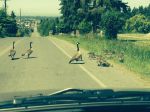
Later that day, as I drove down Third towards town, the goose family was crossing the road. This was an extended family of some sort. The goslings seemed to range in age from itty-bitty-but-able-to-waddle to adolescent-but-still fuzzy. The adult geese acted as sentinels, flanking their young as traffic stopped waiting for them to cross the road. Their necks stretched high, their heads turning once to let me know that they saw me.

Why did the geese cross the road?

So I could get pictures of them. I had plenty of time to whip out my iPhone as they herded the various members of the younger goslings. They weren’t in a hurry. They were determined, however, to get them all across the street safely.
Perhaps the head turning was to say, “These picture better not end up on Facebook.”

They did. And now, they’re on my blog.

These encounters with waterfowl made my day. I can’t even explain why. Or maybe I can.

It just seemed like moments when two species co-existed in the same space at the same time and worked it out.

This seems so fair to me.

I’ve been accused of being a bully recently, in an anonymous post in a comments section on a blog. I had commented on the blog because its author had taken credit for something I had done. When I pointed that out, the author rewrote history again, this time to make herself the victim of my comment.

The anonymous commenter (I believe this was a woman) pointed out that I had a chronic need for recognition and validation. Many, many people agreed with her on this point, as well as my bullying ways, she claimed.

Bullying is nasty. It’s the coward’s way of asserting power by humiliating another simply to gain a sense of power. I think there is a difference between that and standing up for oneself—holding someone accountable for her willful misrepresentation of history to make herself the star of a show she never even participated in.

I do have a chronic need for recognition and validation. Just like that duck and those geese, I believe it is my right to be recognized—to be seen—and to be validated—to have my right to exist in my own space to be respected.

So that’s it. I just figured out why that day was such a fair waterfowl day for me. The universe (as it were) gave me not one, but two opportunities to mess with another creature’s vulnerability. Neither the geese nor the duck were bullies. They were standing up to me and claiming what was theirs to protect and defend. Instead of messing with their vulnerability, I respected it as life expressing itself.

Being smart does not make a woman a bully. Asserting her right to recognition and validation is not a pathology.

I’m not a bully. I’m a strong, smart woman who feels entitled to defend and protect that which she created.

There, I feel better now.

Note: I drove by the geese later that week:

Keep Your Hat On, I’ll End Up Miles From Here

“Keep your hat on. We may end up miles from here.”
Kurt Vonnegut

I’m on a Kurt Vonnegut roll. I recently read If This Isn’t Nice, What Is?, a compilation of his graduation speeches. As I said in my last post, Kurt Vonnegut is living proof you don’t have to be alive to be living.

There’s just something about him. I would have liked to have taken a writing class from him. I imagine he would say this about writing: “Keep your hat on. We may end up miles from here.” He actually did say that. I just don’t know for sure if it was about writing.

I attended Fourth Friday last Friday, the local venue for writers to listen and read. The featured writer was Holly Hughes who read from her book of poetry, Sailing with Ravens. It was important, she said, that instead of diving in randomly to read poems in her book, that you start at the beginning and continue on.

From the back of her book:

“Gillnetter, mariner, and naturalist Holly Hughes has experienced first-hand the practical and philosophical consequences of navigating difficult waters. . . . In this exquisite collection of poems Hughes deftly navigates the ‘wavering, certain path’ of a woman’s heart, finding that sometimes the best directions to follow are those that come from the natural forces in our lives. . . .”

I’ve been on the ocean—I spent 75 days on a Dutch freighter traveling from Saudi Arabia to Long Beach, California. We went days without seeing either land or another ship. Once, we patiently watched for what in my memory seems like hours for a ship to transform from being a dot on the horizon to a sister ship gliding by alongside us, bow to stern, and then sail away to become a dot on the horizon again.

And then we were alone on the vast expanse of water with the occasional school of dolphins that appeared.

The ship I was on raised three stories off the surface. I can only imagine what it would be like to be on the 33-foot fishing boat Holly Hughes set sail in—what it was like to be at sea with that much uncertainty surrounding you.

It occurred to me as I listened to her that she did what writers do—she saw the poetry in the prosaic. I think at the heart of being a writer is an understanding that we “ . . . never had to leave home to be writers, because there are people there just as smart and just as dumb, just as kind and just as mean, as anywhere else in the world.” Kurt said that, too.

I’m having a serious Kurt crush these days.

Somehow that gives me permission to leap into this next thing I’m going to write about: tent caterpillars in my trees.

They are voracious little creatures, eating anything leafy. Not the evergreens—the tasty leafy things like the leaves on the apple and cherry and pear trees.

Side thought: With all due respect, they sound very much like us humans who are sort of kind of’ ravaging the planet—not by eating the leafy things but by changing the climate with our behavior and modifying the genetics of plants and planting plants that have been pre-treated with systemic pesticides that kill bees.

But, back to the tent caterpillars.

I am faced with a decision . . . do I get rid of them, or just let them cycle through. There is a non-poisonous solution: Bacillus thuringiensis (Bt). It’s made from dead ground up caterpillars and introduces a bacteria that they eat and then get sick and die before they become moths and lay eggs. Or maybe they lay eggs and then become moths, I’m not entirely clear on that concept. But they die before they become moths.

The point is that by introducing Bt into their world, I interrupt their transformation. I keep them from learning what it means to take flight.

Which gives me pause.

Note: Literally, it gave me pause. I removed my hands from the keyboard and put them in the pockets of my fleece vest, wondering where I’m going with this. Hold on for the play button.

I’m back. I stepped outside to the balcony. Birds were singing and in the background I could hear Tom’s music playing on the iPod inside my writing Shed. They didn’t compete (the birds and Tom’s music). They complemented each other. Here’s what I saw.

So here’s what I think. I will spray the Bt. It doesn’t poison other insects (maybe mosquitoes, I’ll research that and I’m okay with that because of the equine virus thing, though I suspect that mama equine viruses love their equine virus children as much as we love our children). I think that introducing the bacteria will give the trees a fighting chance.

Now, will it kill all the tent butterflies? Probably not. I suspect there will be some who will survive the bacteria. Which could mean that they will create a new generation of tent caterpillars that adapt to the bacteria. That is the cycle, I think.

Maybe I’m overthinking this.

Where was I?

Oh, right the transformation-interruptus thing.

So, here’s where I am with that: what I will be doing is introducing living things that interact with each other into the environment. Apparently there is a three-year cycle of tent caterpillars getting overly enthusiastic about reproduction. This is the third year of that cycle, or maybe the second, depending on who you talk to.

I think what I’m doing is giving my trees a fighting chance of staying clothed and producing fruit. I’m okay with that and I apologize to the moms and dads of the caterpillars whose offspring won’t get a chance to take flight. I think they might have had a good life anyway. They certainly are beautiful creatures.

And, for what it’s worth, I suspect that bacteria are hard at work thinning out the human race.

That’s the cycle of things. Or, as Kurt would say, “And so it goes . . .”

If This Isn’t Nice, What Is?

We have to be constantly jumping off cliffs and developing our wings on the way down.
Kurt Vonnegut

Kurt Vonnegut is living proof that you don’t have to be living to be alive.

I thought I was going to be writing about Cougars today. Cougars being what older women who are involved with younger men are called. One definition defines it as an older woman (35 or older) who preys on younger men.

Older men who are involved with younger women, on the other hand, are generally referred to as Lucky. I think men start being considered older at 50.

Whatever, this age thing is absurd. I remember an episode of Picket Fences where the widowed father of the character played by Kathy Baker (I think the character’s name was Jill) brought the much younger woman he was involved with to Thanksgiving weekend. Chaos, outrage, and judgment ensued. Jill became unhinged.

Then, came the reveal. Her father wanted someone younger because he didn’t want to have to go through losing another spouse to death. The younger woman, however, had cystic fibrosis. She would not live to be an old woman. She would die a young woman. She wanted to be involved with an older man because his experience of life was closer to hers—they were both closer to the end, rather than the beginning of their lives.

It turned the age thing on its head.

I don’t know whether it is only American culture that is so clueless about what to make of women as we grow older. Actually, I think it is more accurate to say, “I don’t know whether it is only American culture that is so terrified of women as we grow older.”

The meaning for the Cougar in the Animal-Wise Tarot card deck is “coming into our own power.” I think of that every time I hear a woman referred to as a Cougar. That is certainly what growing older means to me—shedding whatever isn’t my story to make room for what is my story.

Whew! What a relief. I don’t need to worry about being nice anymore. Not that I always was, but at least now I don’t worry about whether what I do is nice, or not.

Being kind is another thing. Kurt Vonnegut also said, “There is only one rule that I know of, babies—, Goddamnn it, you’ve got to be kind.”

I think it is kind to live and tell your own story, and respect that others are doing the same.

The end parenthesis that is death makes for good grammatical living. It forces us to pay attention to meaning, or perhaps more important, meaningfulness. It’s been almost a year since we took the leap to start the next phase of our lives (Tom’s and mine). It has taken much longer than either of us thought to settle into our home. Where we put things, hung art, placed books on shelves took on a deeper meaning to us. There was awareness that this could be the last place we live. So how did we want to do it—live our lives.

We were a bit like a deer caught in the headlights. It was disconcerting and for a while innervating. But that still time was necessary. Then there came a point where we just plunged ahead. We jumped off the cliff so we could develop wings. And so we discovered our new home. We live in beautiful surroundings. Our home is filled with art and books and music.

“If this isn’t nice, what is?”

That’s also a quote from Kurt Vonnegut. His Uncle Alex used to say that to note a particularly lovely moment, like sipping lemonade under a shade tree in summer. Uncle Alex thought it was a terrible waste to be happy and not notice it. (Oh, right, I live in Happy Valley).

And so, as I become a Cougar, I fill my heart with power, knowing that there is no time like the present to embrace my story and live it assertively.

I leave you with one last quote from Kurt Vonnegut, “Practicing an art, no matter how well or badly, is a way to make your soul grow, for heaven’s sake. Sing in the shower. Dance to the radio. Tell stories.”

All quotes in this post are from If This Isn’t Nice, What Is? The Graduation Speeches by Kurt Vonnegut. I read it in one sitting. When I finished I thought—if this isn’t nice, what is?