A Wart on So Much Happinness

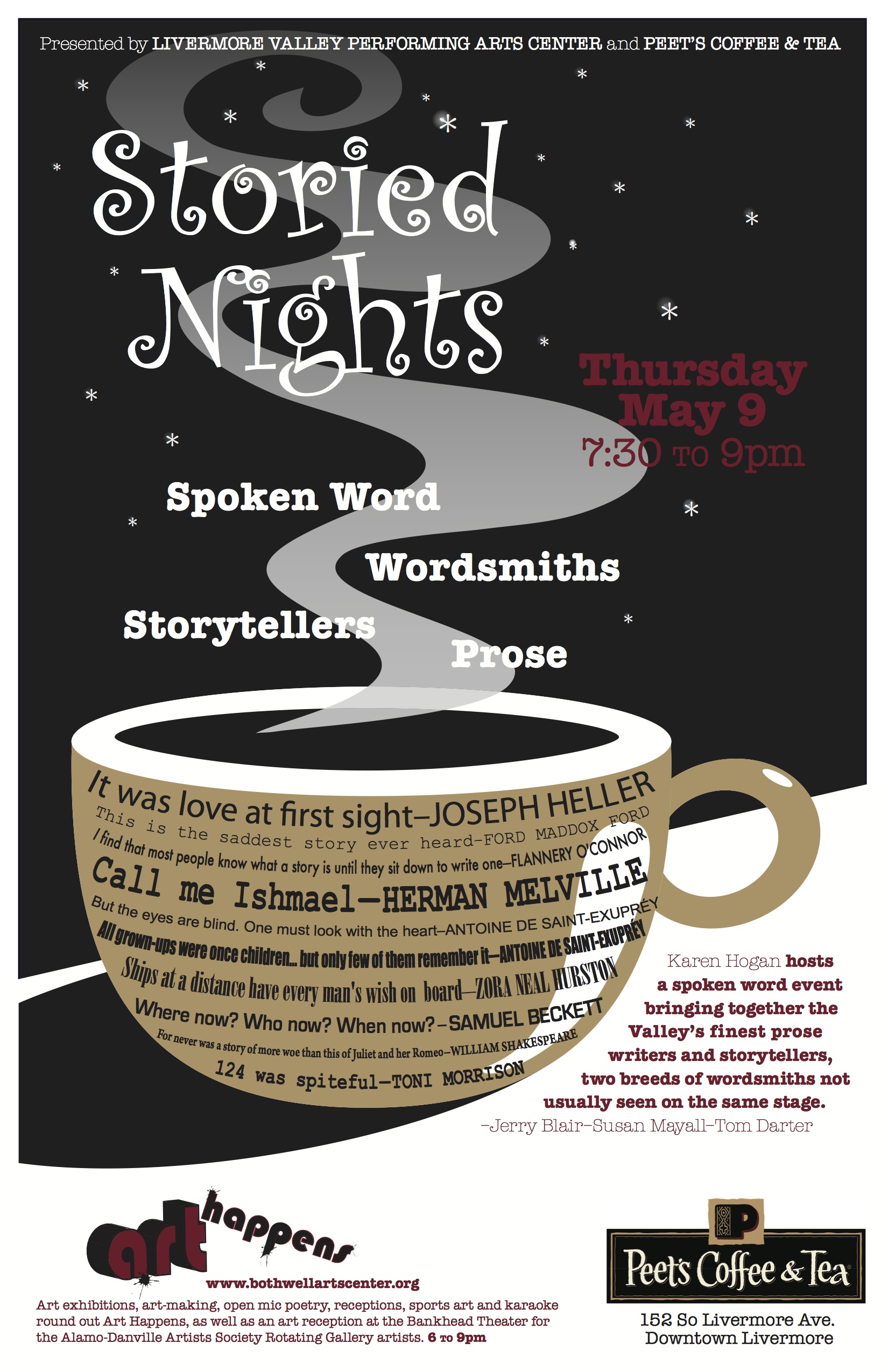
Storied Nights_11x17I don’t normally use my blog for this kind of post, but I think it is important that my voice be heard about Storied Nights: an Evening of Spoken Word, a venue in Livermore that brings the art of writing into the cultural event called Art Happens. It started in May 2013 with me as the host.

Here is my story.

I had tried for years to provide a venue that would recognize prose writers. Livermore had a poet laureate, but the founding and succeeding laureates would give at most lip service to the art of prose, claiming it to be an inferior cousin to poetry. I never did understand this. I am in the camp of poet Marianne Moore who said that an attempt to differentiate prose from poetry was a “wart on so much happiness.”

For eight years, I hosted Saturday Salons at Fourth Street Studio, where poetry and prose happily co-existed. I had to close Fourth Street Studio in 2011 because I could no longer afford to keep it open. I called it Livermore’s Literary Arts Center.

Once I closed it, I began a quest to find a venue that would elevate the art of story on par with poetry. In addition to the bi-monthly poetry readings, the poet laureate created another venue—one that would be part of the downtown Art Happens (similar to an Art Walk). It was poetry only. It would not accommodate prose.

I sought advice from Len Alexander, who was then the Executive Director of Livermore Valley Performing Arts Center (LVPAC). We met for coffee several times to discuss bringing story to Art Happens. It was clear to me that it needed a sponsor, I could not do it as an individual. He said he would see what he could do.

Time passed. Tom and I took a walkabout that took us to Sequim, Washington. Economics and time-of-our-life changes intersected and we decided it was time to sell our house in Livermore and head to the great North West.

The week we returned, over coffee, Len told me that he had found a venue and LVPAC wanted to sponsor Storied Nights: An Evening of Spoken Words. The first event would be in May. I told him my news that we would be leaving, but that I could definitely organize and host the first event (perhaps the June event as well) and that I would find someone to run with it after I left.

And that is how I came to ask the current host if she wanted to take over where I left off. She was not the first person I talked to because earlier in 2013 when I asked if she was interested in working with me to find a venue, she said she didn’t have the time. I was grateful that the timing was right for her to step in and take it over.

Much to my dismay, from the beginning, she began to rewrite history, claiming that the Chair of the Commission for the Arts, rather than I, had asked her to host this new series, and implied that she would be launching the series. I do not to this day understand why one would do that, essentially scrubbing me from the picture.

I worked hard for ten years to establish a venue for writers in Livermore. Besides hosting the Salons, I published five anthologies, organized release parties for each, and produced several Unusual Evenings of Spoken Words. I had to swim upstream—and I will never understand this either—because there was an unspoken rule that there was not room for both poetry and prose in Livermore.

The current host was the right choice to take over Storied Nights. She ran with it, made it her own, and from what I can see on Facebook, it is thriving. She is starting an open mic night in the tradition of Saturday Salons and continuing the quest to open a literary arts center to replace Fourth Street Studio.

I don’t know whether she doesn’t understand the value of what was given to her—a series with a venue in place, a pretty robust email list, and a built in community of writers to select from for readings—or if she is choosing to ignore how my efforts led to the series.

In our final coffee meeting before I left Livermore Len Alexander gave me a framed copy of the poster for the event that launched the series and told me the series was my legacy.

My biggest frustrations during my time in Livermore was a cultural undercurrent that held that there was not enough to go around—not enough talent, not enough skill, not enough enough. More than once, my contributions were implemented but I was denied credit for them, even though there was documentation that backed up my contributions.

I am absolutely baffled as to why diminishing another is somehow necessary for one’s success. I am also hurt by this.

I have gone back and forth as to whether or not I should write about this—or more accurately whether I should publish what I write. If you are seeing this, I made the decision to publish it—not to settle scores, but because I think it is important that artists get their due, and that they stand up for themselves when it is denied them.

I also hope by posting this, I can show that the notion that you have to diminish and demean others to elevate yourself is, to quote Marianne Moore, “a wart on so much happiness.”
Time Enough

. . . when you have lived your individual life in your own adventurous way and then look back upon its course, you will find that you have lived a model human life after all.”
~From Thou Art That by Joseph Campbell

I have an ongoing and interesting — let’s call it a discussion— with a friend I have known since our childhood. He is an atheist. I have no idea how to label myself with regard to “theist.” It confounds him that I am neither an atheist or have a theism. There are only two camps I think for him.

Someone once said that what I had was a cosmology. I’ll buy that.

I think I was 10 when I had a dream about heaven. Two men sat on thrones, one slightly lower than the other. One had a long white beard, the other — well, I don’t remember much about what he looked like. But I did know that it was God and Jesus. They were surrounded on either side by piles of flat, oval shaped objects. Those were souls.

It was at that point that I realized the stories I had been told about God and Jesus and heaven were as flat for me as those ovals piled high on either side of the thrones. That idea of heaven no longer had any pull for me.

But, I still yearned for stories. I wanted stories that would make sense out of it for me. I don’t know that I even knew what “it” was or the sense that I was looking for. Perhaps it was Eddie English, a regular patron of the Wishing Well, where I tended bar from 1978 to 1980, who defined “sense” to me.

Eddie was a retired Muni conductor. He piloted the N-Judah line, which ran right outside the bar on Irving Street. Let’s just say it was a different era when he was in charge—legend had it that he would disembark if there was a red light and run into the bar to get his shot of whiskey, then run back to the streetcar and send it merrily on its way to Ocean Beach.

I only knew him in retirement. He always came in impeccably dressed, a dashing figure with sparkly blue eyes. He would order his drink and begin telling me stories. It was always at least three stories that were randomly intertwined. He would start with one, then insert the middle of his next story while in midsentence, maybe return to the first or start another, eventually come back to the beginning of the second story, or maybe not.

Listening to him was like reading Finnegan’s Wake, or at least I think that’s what Finnegan’s Wake is like—I’ve never had the ovarios to read it.

At any rate, I had learned that if you didn’t try and follow him, you could follow his stories. But the minute I tried to make sense of what he was saying, I got lost in the jumble.

One time I asked him, “Eddie. Have you ever made sense?”

“What’s sense without love?” he asked me, engaging me with those blue eyes. He sipped his drink, answered his own question: “Nonsense,” then started a whole new series of stories.

I have been attempting to make sense of my life recently. I am in awe of younger women acting with such determination in their lives. I see it and think if only I had known that. I am in even greater awe of women my age and older who acted with determination. How did they know that? Or, more to the point, why didn’t I have the ovarios to do that?

There are no do-overs for a life. One just does what one does, making the best decision, making the best choices, calling on whatever information one has at the moment of decision or choice.

Much of my earlier life was spent trying to please two mistresses: the voice of the matriarch and my actual voice. The matriarchal voice was all about getting married. That was the goal, the brass ring, the what-the-point-of-my-life-was-to-be.

I married twice to try and please the matriarchal voice. But I made choices that gave me an escape hatch. Neither really fulfilled the role of the brass-ring husband, so that made it okay for me to walk out on a marriage. I was the victim. Had I married someone who was the brass ring (good provider and so on), I would have been trapped because marriage was about finding the good husband—the one that could make you the top dog in the matriarchal hierarchy. Forget any notion of having a life of one’s own.

I never really followed a “career.” I didn’t make choices about relationships based on whether or not it interfered with my “career.” A career was never my life. I never considered that. But at some point I decided that my career was the life I was living and wanted to live.

Which is probably why I’m a writer. It’s more avocation than vocation.

If I had had more determination, I very well might be more financially endowed at this point in my life. I have been imagining what my life might have been like if instead of flying under the radar of the one mistress I had spoken with my actual voice. Frankly, I can’t imagine it. Because I only know what I know now because of the decisions and choices I made based on the information I had at the time.

I think it’s Isabelle Allende who said experience is what you get right after you need it.

Work is finally done on our new home. I finished directing and acting in Love, Loss, and What I Wore, transplanted the Unusual Evening series from Livermore to Sequim, and am finally unpacking the boxes and boxes of books and files and various icons that were in Writing Shed 1.0. I am finally getting my books in alphabetical order so I know how to find the one I’m looking for. I have a separate set of shelves for women writers; a set of shelves for my printer and writing reference books; a separate set for poetry and theater; and I will probably separate out anthologies from the rest of the books.

It’s a bit overwhelming. My floor is once again strewn with books. I stop when it becomes too much, take a break, knowing I will come back to it tomorrow—and that I don’t have to rush into anything.

And, that’s the glory of this new adventure in my life—my move to Sequim. I don’t have to know by tomorrow. I can give myself the time to reflect, to draw on a life that I have lived in my own adventurous way—tending bar, for example; working at a topless bar as a secretary as another example; being a hospice volunteer as yet another example—to make decisions and choices.

One never knows how much time one has. I think the trick is to make sure that whatever time you have, that it is time enough.

The question of heaven is rather moot. Who needs heaven if you had time enough?

The Woodpecker on the Telephone Pole

Most mornings, since spring has begun appearing, I hear the Morse-code-like tapping of a woodpecker on the pole that delivers us phone and Internet services as I go to the mailbox to retrieve my New York Times.

My grandmother, who was born in 1889, wanted to be a telegrapher. She wanted to be the one who tapped out messages to send and interpret the tap-tap-tap of the messages received so she could deliver messages—personal and newsworthy. I think she wanted to be connected to the world outside the small one she inhabited in the town in Oklahoma that had grown from a village of tents and dirt roads into one of houses and sidewalks and streets from the time she moved there as a five-year old until she married my grandfather.

She married at 19. She looked around at her options, decided there were too many children still at home (she was the oldest of nine) for her to get educated as a telegrapher, and so married my grandfather—who was considered quite the catch.

My grandfather was a good provider, taught Sunday School, everyone loved him—and he was a womanizer and molested me and who knows who else. His middle son was also a child molester. He molested me and who knows who else.

I, of course, kept the secret from the family for nearly 30 years, until I told my mother when I was 40. She believed me, felt terrible that I hadn’t been protected—that she hadn’t protected me—but said she could forgive my grandfather because my grandmother had stopped having sex with him.

I suspect that if she could have heard herself, she would have been appalled. But, I think the really deep need to believe that the old stories will keep you safe prevailed with her.

What I came to call the family recipe—that girls and women are the sacrificial lambs on the altar of family stability—is the old story that prevailed with the women in my family. It is a story that has power because it is also one that has prevailed culturally.

Perhaps the most disturbing thing about that story is what it does to marriage and family. It reduces them to a trap for women. More than one woman has chewed off her arm to release herself from that trap.

What I like most about Nora Ephron is that she believed in romance and love and wanting to marry and being married—and advised Wellesley graduates:

Whatever you choose, however many roads you travel, I hope that you choose not to be a lady. I hope you will find some way to break the rules and make a little trouble out there. And I also hope that you will choose to make some of that trouble on behalf of women.

Here’s a link to the full address, you won’t regret reading it:

http://www.huffingtonpost.com/2012/06/26/norah-ephrons-commencement-96-address_n_1628832.html

I am distressed that a woman named Susan Patton, a 1977 Princeton graduate, is distorting the very real desire to be connected, to be married, to have a partner, is reducing it to the old story. If that’s what you want, she says, you need to compromise your self, because love and marriage and family is about competition for the good catch:

“If you spend the first 10 years out of college focused entirely on building your career, when you finally get around to looking for a husband you’ll be in your 30s, competing with women in their 20s. That’s not a competition in which you’re likely to fare well.”

Here’s the link to the editorial in which her quote appears. You might regret reading it:
http://dailyprincetonian.com/opinion/2013/03/letter-to-the-editor-advice-for-the-young-women-of-princeton-the-daughters-i-never-had/

(I saw her interviewed by Mika Brzezinski on Morning Joe and found myself shouting at the TV, “MIKA. GET THE FUCK OUT OF THAT BOY’S CLUB BEFORE IT’S TOO LATE.” I often find myself shouting at Mika to get out before it’s too late.)

Marriage isn’t about finding the good catch. As the dad says in Juno, to paraphrase, it’s about finding someone that thinks the sun shines out your ass.

It took me three times to find the right match. Finding someone who is as smart as I am and more important, who isn’t afraid that I’m smart. A man whose emotional intelligence matches his intellect. And perhaps most important, a man who doesn’t believe in the sacrificial lamb myth. He almost knocked me off my feet when he said to me, just as we were getting to know each other, “You’re really good at nurturing, but maybe that’s not what you do best.”

I’ve written about this before—how difficult it is for me that my mother died while there was a chasm between us. We had always managed to bridge it before. But I think it is only now that I have been able to understand just how great the chasm is between marriage and family as a trap and marriage and family as a nourishing home.

I so wanted my mother to come with me when I decided that I could not sacrifice myself to family peace. But she died before she could. I’d like to think that had she had more time—time in which the struggle to breathe was not a breath-by-breath struggle—she would have come with me. I’ll never know and I miss so much what we missed.

At first, I wondered when I heard that woodpecker on the telephone pole, whether he’s pecking away to find insects. Wondering if it is for naught—do insects reside in a telephone pole?

And then recently, it flashed across my mind that maybe it’s my grandmother tap-tap-tapping away to send me a message that all is right with the world. That the matriarch of the family finally understands and sends me her blessing through Morse code.

And that my mother sends hers as well.

When Your Butt Can’t Be in the Chair

There is that day when you know the season is changing. It’s something about the light, the feel of the air against your skin, the sounds in the early morning.

This is my first March in my new home in the Northwest—a home sheltered by a rainshadow, but I think I’m right—spring has taken the baton from winter. Either I am hearing birds again in the morning, or there are new birds with new songs. At night, the symphony of the frogs fills the air. Mystery flowers are pushing their way up to the surface. And, the days are longer.

I have been off the grid blog-wise since the end of November. Sometime in November I either tore my meniscus or it tore itself. I’m not sure. I’d like to claim that it was due to an aggressive swoop down a ski slope—but me and skis have never seen fit to be good company.

I believe my meniscus tore because it has been around for 64 plus years and just got tired of being ignored. It worked. I learned I had something called a meniscus.

I am a stranger to pain. I have not had children so can only imagine the pain of childbirth. I’ve never had a severe injury—I sprained my wrist when I was in sixth grade, but I got a Dr. Pepper out of that. The pain eased pretty quickly.

A torn meniscus is really, really, really painful. It interfered with my sleep because I sleep on my side. I had to adjust to sleeping on my back—waiting for the pain to ease.

I relied on marijuana for pain medication. I can attest that it works, and it gives you creative ideas for chip and dip—Moose Track ice cream with vinegar and salt chips, an idea way before its time—and it isn’t habit forming. The marijuana or the ice cream and chips. Fortunately, I live in a state where it is legal.

It’s true that you don’t remember pain. But I do know that during the two months it took to recover, I couldn’t write. For one, I couldn’t sit down for long periods of time—long being more than ten minutes at a time. So much for the butt-in-chair mantra.

For another, pain clouded my brain. I simply could not write. Or to be more precise, I could not think—except for thinking about how debilitating it is to have a knee that doesn’t work right. Who knew how important knees are? Well I do now.

I wonder if this is what a bear feels like when she comes out of the den after a winter’s slumber? Awakening to a world that has changed, lightened up, alive with signs of new growth, and chilled air that touches lightly on your skin.

After a long winter’s slumber, I have a new appreciation for my knees and mobility.

I also have a new appreciation for hibernation. I think sometimes, change is so great that we have to slip into a deep sleep to let it wash over us, trusting that where it takes us is to the place we need to be—a place of changed light, new growth, and chilled air that touches lightly on our skin.

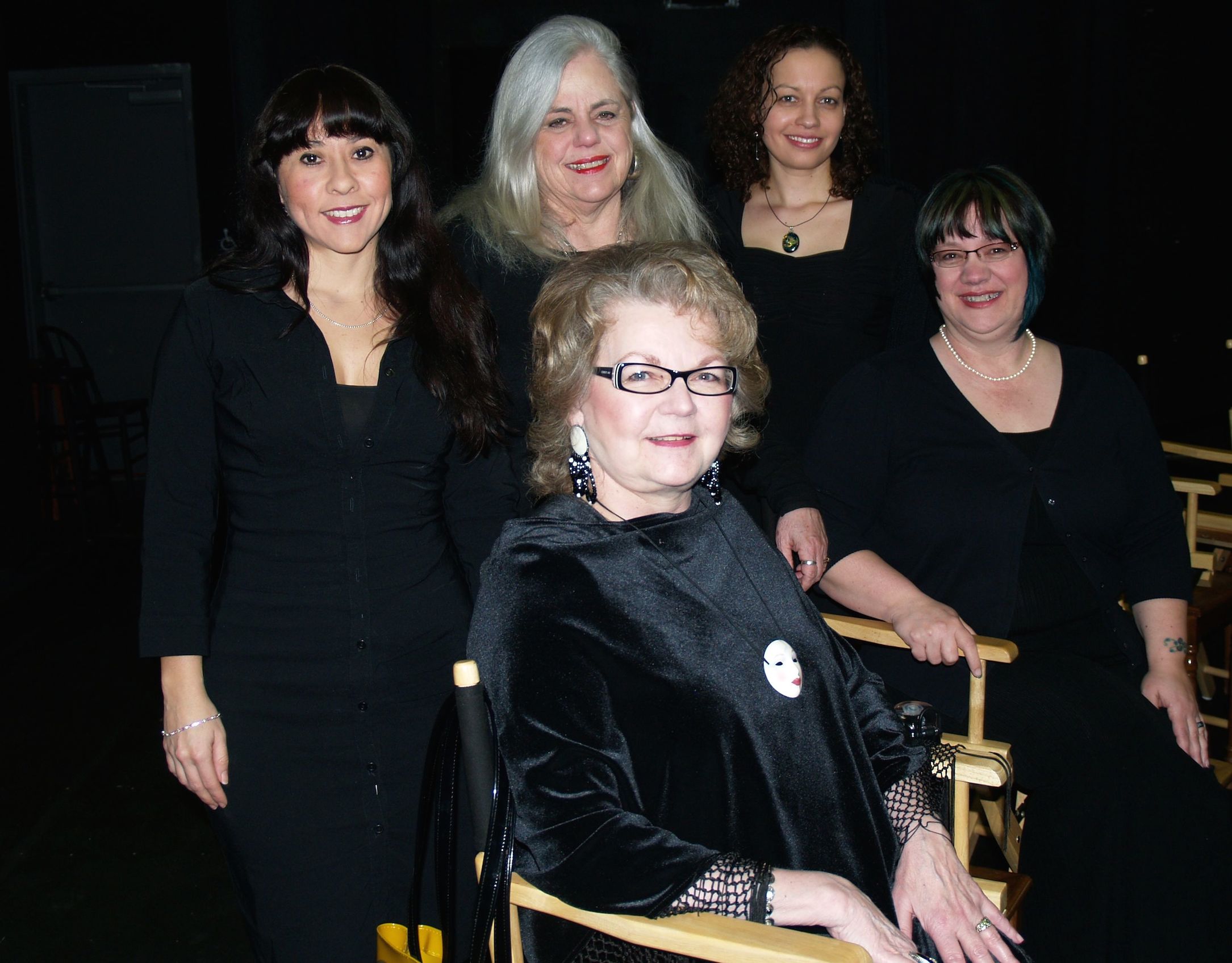
Cast of Love, Loss, and What I Wore. Back row: Nina Mendiburu, Me, Lola Bond; Front row: Sharon DeLaBarre, Susan Dwyer

Cast of Love, Loss, and What I Wore. Back row: Nina Mendiburu, Me, Lola Bond; Front row: Sharon DeLaBarre, Susan Dwyer

I am directing and acting in a production of Love, Loss, and What I Wore (written by Nora and Delia Ephron). What a great experience to say words aloud that have been written by such awesome women—not to mention the awesome women in the cast who are speaking their words.

November 22, 1963

Football season was done. I think it might have been the first Friday without a football game. But it was Friday, so we had to do something. We planned on going to the Vine to see West Side Story. Back then, it took a few years for “big” movies to get to Livermore.

The bell hadn’t rung yet to mark the start of fourth period. Kids were still straggling in to Mr. Fraser’s fourth period Freshman English class. I had just taken my seat when Mr. Snodgrass and Mr. Weiss rushed in, pulled a radio from the closet in the back of the room, then just as quickly left the room. I remember thinking it seemed strange. They looked so grim.

By the time the bell rang, we knew. We heard. President Kennedy had been shot. Mr. Fraser led us in a discussion. We talked about politics, who was Democrat and who was Republican. He managed our bewilderment, kept it light, told us he was a Republican, then said we should use the remaining time to read our assigned book—Great Expectations.

Pete Prassinos, he of the beautiful deep dark brown eyes framed with long dark eyelashes, asked if he could go to his locker to get his book. Across the hall, Mr. Satterthwaite had the radio on, the scratchy sounds of the newsfeed barely audible. Pete returned with his book.

“He was shot in the head,” he said pointing to his temple.

Moments later, we heard the news bulletin clearly. The president was dead.

“Well, that’s it,” Mr. Fraser said and turned away from us.

“President Kennedy has been killed,” the voice over the public address system announced. “School is dismissed.”

The boys in the back row jumped up and cheered. Not because Kennedy was dead, but because school was dismissed. They were teenage boys who didn’t know how else to react.

“Hey!” Mr. Fraser boomed. He was barely five foot two, but his glorious voice drove the hulking members of the football team in the back row into their seats. “A man is dead! The president is dead. We need to respect that.”

And with that, he dismissed our class.

There were other things that remain vivid in my mind from that weekend:

My mother cleaning house wearing the skirt and blouse and heels she had been wearing when she was at the store and heard the news. My mother hated housecleaning and never—never—before or after that Friday wore heels and a dress to clean the house.

My father, the next day, threatening to break the Vaughn Meader record that lightly satirized Kennedy. My dad was an Irish Catholic. That was a big thing to him: an Irish Catholic as president.

Seeing Oswald shot on Sunday morning.

Going to see West Side Story on Sunday afternoon with Mary Ann Kriletich, Kathy Smith, and Kathy Keene. Weeping as we walked home, comparing Jackie to Maria, remembering that Jackie had lost a child just months before.

On Monday, the riderless horse, boots placed backwards into the stirrups, preceding the coffin as it made its way to Arlington. I had seen the same image in the previous week’s Life magazine, an illustration that accompanied an article about the assassination of Archduke Ferdinand—perhaps because Barbara Tuchman’s book, The Guns of August, had influenced Kennedy’s handling of the Cuban Missile Crisis.

We returned to school on Tuesday. It was a two-day week. Thanksgiving was on Thursday.

The Beatle’s arrival in February of 1964 took the focus off of Kennedy’s death. Or at least, that’s my memory. The trauma of the assassination of a president receded, seemed a mistake, something that still couldn’t happen here.

Over next five years, civil rights workers were murdered, fire hoses and dogs let loose on peaceful marchers, cities rioted. The war in Vietnam escalated, driving a wedge between generations—those who fought the “Good War” and those who questioned why we were at war.

By the time Martin Luther King and Bobby Kennedy were killed five years later, we came to believe that assassinations were part of the American landscape.

I had Mr. Fraser again in my senior year for English Honors. That was his last year teaching high school. He had been accepted into the Master’s program at San Francisco State College (later University); I was heading there, too. I saw him once in the Humanities Literature and Language building, drinking from the water fountain.

I later learned that he did not make it through even the first semester. Academia, he quickly learned was not the place for him. He left for New York where for years he made a living doing voiceovers and acting bit parts in soap operas.

In 1996, on a trip to New York, Tom and I reconnected with Mr. Fraser. He had been Tom’s teacher as well. By that time we called him Bert. I thanked him for how he took care of us, my fourth period English class, the day Kennedy was killed. “You gave us a safety net in a very confusing moment,” I said. “And you showed us how important and sad that moment was.”

We agreed to keep in touch. We invited him to our wedding that September, but he was unable to attend. Sometime soon after that, a heart attack took him.

Mr. Fraser introduced me to William Faulkner’s Nobel Prize speech in English Honors. I had to write a paper showing how the convict in “The Old Man” exemplified the sentiments of his speech. I don’t remember my paper. It’s been too long since I read the short story to be able to tell you how it exemplified his sentiment.

But Faulkner’s speech has stayed with me over the years. I go back and read it from time to time. With each reading, it resonates more deeply with me.

Innocence and experience. Experience does not necessarily lead to cynicism. It can, if we are willing to go deep enough, lead us to a deeper understanding of what it means to be human, how to wend our way through sad times. I was fortunate, that on that awful day, November 22, 1963, I had Mr. Fraser as my guide.

From Faulkner’s speech:

“I believe that man will not merely endure: he will prevail. He is immortal, not because he alone among creatures has an inexhaustible voice, but because he has a soul, a spirit capable of compassion and sacrifice and endurance. The poet’s, the writer’s, duty is to write about these things. It is his privilege to help man endure by lifting his heart, by reminding him of the courage and honor and hope and pride and compassion and pity and sacrifice which have been the glory of his past. The poet’s voice need not merely be the record of man, it can be one of the props, the pillars to help him endure and prevail.”