Sense Without Love

Eddie English, a long-time regular at the Wishing Well, where I tended bar in the late 70s, spoke like a James Joyce novel. He had three or more stories going at once, would slip easily between them as he spoke, gliding from beginning to middle to end at his own rhythm.

I could follow his narrative as long as I didn’t try. The minute I tried to make sense of him, I got lost in a Saragossa Manuscript that started in the middle then moved randomly between stories.

“Eddie,” I asked him once, “have you ever made sense?”

“What’s sense without love, darlin’?” He took a sip of his Manhattan and pierced my bartender veil with his intense blue eyes and his reply. “Nonsense.”

Sense without love is nonsense.

I thought of Eddie’s assessment this past week as Republican senators questioned Sonia Sotomayor.

They worry that she might not be qualified to render justice because she is Latina woman. Her life experience as a Hispanic woman taints her view of the world.

Empathy, they say, will skew her judgment. For example:

Because she is a woman, she might understand that her role in bearing a child is not simply that of incubation.

Because her affirmative action advantages were granted to her because of her potential, rather than by privilege of birth, she might understand that nobility is earned through grace under pressure.

Because she has lived life as a woman and a Latina she might have an authority of experience that questions the authority endowed through power and legacy.

Lindsay Graham wondered, what about her temperament? She is known to ask penetrating questions. He doesn’t like that. Doesn’t like being “bullied” by judges. Doesn’t like not being treated with the kid gloves boys in the old boys’ network treat each other. Perhaps finds it particularly uncomfortable coming from a Hispanic woman who in his experience is the one who cleans the house and tends the children of the privileged.

Some commentators are saying that the Republicans have succeeded in shooting down empathy as a value.

I hope not.

The country cannot endure such nonsense.

How the Past Flows into the Future

The present. That’s how the past flows into the future.

I don’t remember when I first heard that. I think it might have been in Michael Zimmerman’s American Literature class at San Francisco State University. I don’t know where he heard it.past to future1

Whether we’re there or not, that’s where we are at any given moment: the present.

No big surprise to me, I heard from my friend Jim after my last post, challenging my concerns about the National Ignition Facility – or rather my concerns about the application of the knowledge we might get from creating a star in a bottle, as the Lab’s PR describes it.

past to future maybeIf I want my grandnieces and -nephews to have energy in the future, fusion might be the answer, Jim admonished me. Besides, fusion-fueled weapons have been with us for 50 years, so what’s the big deal, he asked.

This morning, as I started writing this blog I decided to listen to Joni Mitchell’s CD “The Beginning of Survival.” As I opened the case, I remembered that its title comes from a phrase in a letter (attributed to Chief Seattle) that was sent to the American president in the mid nineteenth century:

Your destiny is a mystery to us. What will happen when the buffalo are all slaughtered? The wild horses tamed? What will happen when the secret corners of the forest are heavy with the scent of many men and the view of the ripe hills is blotted by talking wires? Where will the thicket be? Gone! Where will the eagle be? Gone! And what will happen when we say good-bye to the swift pony and hunt? The end of living and the beginning of survival.

So to Jim, here’s what I would say: I wonder if as a culture, we have become so concerned about survival we have forgotten how to live.

I have no idea what will be in the future. I’m not even sure that we can save the earth. I think the earth is smart enough to save itself; it just might have to sacrifice humankind in order to save itself.

What I do think we can do is draw from our experiences in the past to inform us in any given present moment. But, of course, making present decisions informed by the past is also tricky. Anyone who has repeatedly ended up in the same relationship, regardless of how the outside trappings looked, knows that it might take several mistakes to learn the lesson.

For me, a lesson learned came one afternoon as I stood on a cliff overlooking the Marin Headlands after spending an afternoon in Muir Woods. With the memory of the cool majesty of the redwood trees lingering on my skin, it was as if I looked off into infinity, the ocean stretching out before me, the horizon touching the sky. I understood that I was alone but also a part of everything.past to future infinite

Finite and infinite.

It disturbs me that a goal of NIF is to master the power that powers the universe. The finiteness of our individual lives disqualifies us for that job.

I am not anti-science. Quite the opposite. I think science gives us a view into the universe that inspires awe – not at science but at the mysteries.

I just think any attempt to exert control over the future is folly. All we can do is draw from our past experience, embrace the life that is our present, acknowledge our mortality, and then take the next best step.past to future last

We love this earth as a newborn loves its mother’s heartbeat. So if we sell you our land, love it as we have loved it. Care for it as we have cared for it. Hold in your mind the memory of the land, as it is when you receive it. Preserve the land and the air and the rivers for your children’s children and love it as God loves us all.
Chief Seattle

Go here for a brief history of Muir Woods.

In the Shadow of Birds

I have no idea why it was the red cappuccino machine that surprised me when I got home. We’d had it for a few months. But somehow, it stood out on the counter – a surprising marker that I had returned. Back in Livermore California.
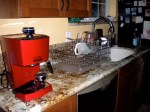
The red cappuccino machine

The red cappuccino machine

There were thunderstorms here before I left. But they were nothing like the thunder and lightning I heard and saw as I walked back to my hotel after sitting out the tornado warning in Iowa City. The sky looked primitive. As if primal soup was brewing – waiting for the big bang to create a new universe.

Earthquakes are more scary, one of the workshop participants said. “At least with tornadoes, you get a warning.”

Yet, somehow, I got no comfort from the warning. I wasn’t scared. I just felt that I was at the mercy of – well, I don’t think I even know whose mercy I was dependent upon.

As we scratched our pens across notebooks in the hallway of the Natural Science Building, the air closed in. I couldn’t see it. Couldn’t smell it. Couldn’t taste it.

But my body felt it – hot, humid, thick air closing in around me. A very slight, but discernable vise-like band tightening around my head, my ears plugging up – like during takeoff – and a film of sweat covering my body, like in a sweatlodge.

And then it was gone. The pressure released, the evaporating sweat cooling my body.

Letting go. Like when the heat in the sweatlodge gets so intense all you can do is let go – and let in.

It’s been twenty years since I participated in sweatlodges on the beach at Bolinas. I had to drive a half an hour, walk through a field that was home to cows, who weren’t sure they could trust me, to get to the cliff overlooking the beach, and then climb down a narrow path to get to the sweatlodge.

It was a journey that had a definite before and after. Whatever concerns and turmoil I brought to the sweatlodge were gone afterwards – the intense heat of the lodge forcing me to get into my body and then let go and let life in.

Circumstances hadn’t changed. But I had.

It was because of last year’s floods in Iowa City that my writing workshops were held in the Natural Sciences building – the newer English and Language buildings were built down the hill from the older buildings, closer to the bank of the Iowa River. The river poured into them and they haven’t yet recovered from the damage.

So, it was the natural sciences that hosted writing workshops. The hallway in which I sat out the tornado warning had glass cases filled with a giant grasshopper and lobster and the torso and head of a giant ape (a replica, no giant apes were harmed in the making of the cases).

Bird dioramas filled the third floor. At the entrance is this quote:

“There is no square mile of the surface of the planet, wet or dry, that has not been crossed by the shadow of a bird . . .”
James Fisher, The World of Birds

owls2And there on display, were birds whose shadows had crossed the surface of the planet: from ostriches to hummingbirds to penguins. Most of the dioramas were more than a hundred years old, dating back to the last decade of the nineteenth century.

From the other side of the display, a bird skeleton, ready for flight, looked like a shaman raising her arms in supplication or blessing.

On the one hand, I realized that a lot of birds gave their lives for these dioramas. On the other, I was in awe of the range of environments birds can inhabit – can cast their shadows.

My artful essayist workshop spent most of one afternoon with the bird dioramas.

I have been going to Iowa City every summer for the past five years to attend the Iowa Summer Writing Festival. There is always a definite before, during, and after for me.

The before part is anticipating it. This year, I was even nervous.

The during part has to do with immersing myself in writing and being among people – instructors and workshop participants – who are there for the writing – for where the writing will take them.

“This is your tribe,” the Festival director said in her opening remarks for the weeklong session I attended.

The during part is letting magic work its course.

The after part is returning to the mundane having traveled the course of magic.

So maybe the red cappuccino maker sitting on my counter surprised me because I am in the beginning of the after part – returning to the mundane .

In my imagination, birds live a life filled with magic. Most sing. Most fly. Some dance to woo a partner. But, perhaps for them, it is just what they do. The mundane routine of their lives.display2

DSCN0014On my first morning home, I made a cappuccino, using my red cappuccino machine, took it to my writing shed and wrote. Later, I organized my laundry. Later still, I drove down First Street and saw that the Vine Theater was showing The Wizard of Oz as its noontime free movie.

If they are looking at me, I wonder if birds think I live a life filled with magic.

Heart of a Whale, Ambition of a Hummingbird

52130040_2083597958395647_2258228293100634112_n

Heart of a blue whale that had washed ashore.

Birds own my backyard. I have the deed to the property, but birds own it.

I don’t know enough about birds to name all who live there, but I can identify mourning doves, mockingbirds, bluebirds, and red-breasted robins. At least I think they are red-breasted robins; they are birds with red breasts.

They come for the grapes, to bathe in the fountain, to nest in the trees and grape vines that cover the pergola, and, I would like to think, to sing. I know that the songs are territorial songs. But who’s to say that our songs aren’t a way to claim our territory.

Did I mention there were hummingbirds in my yard?

In “Joyas Volardores,” Brian Doyle writes that hummingbirds have more heart attacks and aneurysms than any other living creatures. “The price of their ambition,” he writes, “is a life closer to death.”

He also writes that the biggest heart is inside the body of a blue whale. As big as a room. Big enough for a small child to stand in, ducking only to pass through one of its four valves into another chamber.

Little is known of blue whales once they reach puberty, Doyle says. Humans aren’t privy to their domestic habits. I suspect they know how to ride out typhoons.

I spent seventy-five days crossing the Pacific on a Dutch Freighter when I was a kid. Once we left the Phillipines for Long Beach, California, our final destination, we didn’t see any land for two weeks. We sailed through the tail end of typhoons, waves crashing over the bridge, which in calm seas rose three stories over the ocean’s surface.

We were not in our element. That’s how I feel when I fly in a plane. Probably OK, but not in my element.

Doyle says that blue whales travel in pairs and that their songs can be heard underwater for miles and miles.

It seems to me that uncertainty is the pervading force in our culture right now. Crumbling towers and tumbling markets have pitched us out of our element and we are at sea, riding through the tail end of typhoons, but uncertain where we are headed.

Perhaps this is an opportunity.

Maybe if we have the heart of a blue whale and are willing to notice that we always live life close to death, we will know why the nectar is worth the risk to the hummingbird, and we’ll create songs that will be heard beyond miles even we can imagine.

Street Safe

Jeff and I took the information Kaiser Permanente – the original Health Maintenance Organization – had given us for their upcoming Earthquake preparedness proceeding and deftly created story. The Golden Gate, Bay, and Richmond-San Rafael – Bridges had all come down after a 7.0 earthquake hit the Bay Area. Hospitals were out of commission. Electricity was out. Water would be nonpotable after a few hours. The world as the Bay Area knew it had come to a halt.

We delivered the first draft on Monday to the Gatekeeper, the assistant to the engineer in charge of the proceedings.

He leafed through it.

“It’s not meaty enough,” he said. “He’s an engineer. He won’t like this.”

Last words you want to hear from a client.

“I can stall him for twenty-four hours.”

Jeff and I, both freelance technical writers, had been thrown together by the firm that contracted with Kaiser for the project – my first assignment since extricating myself from a very brief, and very ill conceived, marriage. Jeff had recently come out of a relationship and in his words, wasn’t yet “street safe.”

So there we were, two wounded survivors, hungry for connection, who would now have to spend the next eighteen hours, deep into the night, in the office next to my bedroom in Mill Valley, trying to identify meat.

Jeff was funny. And, funny is as much of an aphrodisiac to me as brainpower and nice eyes. He was also smart and had nice eyes. But neither of us was street safe. We spent the night sublimating our hunger by laughing about fictional Penny in Pinole waiting to hear from her husband in San Francisco, and interpreting engineeringese into scenarios the rest of us could understand.

We finished at 10:00 in the morning.

Jeff crossed the Golden Gate Bridge to his apartment in San Francisco to shower and shave. We met again at Kaiser headquarters in Oakland. He’d driven across the Bay Bridge; I crossed the Richmond-San Rafael.

Gatekeeper liked the changes.

Jeff headed back to the City. I had planned to go to a meeting with anti-nuke activists on the other side of Oakland off the Cyprus Freeway.

My brain was still awake enough to consider what it would be like hanging out for two and a half hours to sit through a one-hour meeting. So instead of finding a place to hang out in Oakland, at 2:30 in the afternoon on October 17, 1989, I headed back to Mill Valley.

I arrived about 3:30, took my dog for a short walk, then lay down on the couch.

My first thought was no this can’t be an earthquake, then grabbed my dog and stood in a doorway until the trembling stopped. I turned on my battery-operated radio.

A section of the Bay Bridge had come down. The Cyprus freeway had pancaked. The San Francisco Marina was ablaze. A building façade had collapsed South of Market.

Sixty-three people were killed by the Loma Prieta Earthquake. Most fatalities were caused by the pancaking of the Cyprus Freeway, where I could have been had the Gatekeeper liked our first draft.