In the Shadow of Birds

I have no idea why it was the red cappuccino machine that surprised me when I got home. We’d had it for a few months. But somehow, it stood out on the counter – a surprising marker that I had returned. Back in Livermore California.
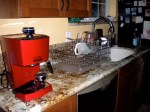
The red cappuccino machine

The red cappuccino machine

There were thunderstorms here before I left. But they were nothing like the thunder and lightning I heard and saw as I walked back to my hotel after sitting out the tornado warning in Iowa City. The sky looked primitive. As if primal soup was brewing – waiting for the big bang to create a new universe.

Earthquakes are more scary, one of the workshop participants said. “At least with tornadoes, you get a warning.”

Yet, somehow, I got no comfort from the warning. I wasn’t scared. I just felt that I was at the mercy of – well, I don’t think I even know whose mercy I was dependent upon.

As we scratched our pens across notebooks in the hallway of the Natural Science Building, the air closed in. I couldn’t see it. Couldn’t smell it. Couldn’t taste it.

But my body felt it – hot, humid, thick air closing in around me. A very slight, but discernable vise-like band tightening around my head, my ears plugging up – like during takeoff – and a film of sweat covering my body, like in a sweatlodge.

And then it was gone. The pressure released, the evaporating sweat cooling my body.

Letting go. Like when the heat in the sweatlodge gets so intense all you can do is let go – and let in.

It’s been twenty years since I participated in sweatlodges on the beach at Bolinas. I had to drive a half an hour, walk through a field that was home to cows, who weren’t sure they could trust me, to get to the cliff overlooking the beach, and then climb down a narrow path to get to the sweatlodge.

It was a journey that had a definite before and after. Whatever concerns and turmoil I brought to the sweatlodge were gone afterwards – the intense heat of the lodge forcing me to get into my body and then let go and let life in.

Circumstances hadn’t changed. But I had.

It was because of last year’s floods in Iowa City that my writing workshops were held in the Natural Sciences building – the newer English and Language buildings were built down the hill from the older buildings, closer to the bank of the Iowa River. The river poured into them and they haven’t yet recovered from the damage.

So, it was the natural sciences that hosted writing workshops. The hallway in which I sat out the tornado warning had glass cases filled with a giant grasshopper and lobster and the torso and head of a giant ape (a replica, no giant apes were harmed in the making of the cases).

Bird dioramas filled the third floor. At the entrance is this quote:

“There is no square mile of the surface of the planet, wet or dry, that has not been crossed by the shadow of a bird . . .”
James Fisher, The World of Birds

owls2And there on display, were birds whose shadows had crossed the surface of the planet: from ostriches to hummingbirds to penguins. Most of the dioramas were more than a hundred years old, dating back to the last decade of the nineteenth century.

From the other side of the display, a bird skeleton, ready for flight, looked like a shaman raising her arms in supplication or blessing.

On the one hand, I realized that a lot of birds gave their lives for these dioramas. On the other, I was in awe of the range of environments birds can inhabit – can cast their shadows.

My artful essayist workshop spent most of one afternoon with the bird dioramas.

I have been going to Iowa City every summer for the past five years to attend the Iowa Summer Writing Festival. There is always a definite before, during, and after for me.

The before part is anticipating it. This year, I was even nervous.

The during part has to do with immersing myself in writing and being among people – instructors and workshop participants – who are there for the writing – for where the writing will take them.

“This is your tribe,” the Festival director said in her opening remarks for the weeklong session I attended.

The during part is letting magic work its course.

The after part is returning to the mundane having traveled the course of magic.

So maybe the red cappuccino maker sitting on my counter surprised me because I am in the beginning of the after part – returning to the mundane .

In my imagination, birds live a life filled with magic. Most sing. Most fly. Some dance to woo a partner. But, perhaps for them, it is just what they do. The mundane routine of their lives.display2

DSCN0014On my first morning home, I made a cappuccino, using my red cappuccino machine, took it to my writing shed and wrote. Later, I organized my laundry. Later still, I drove down First Street and saw that the Vine Theater was showing The Wizard of Oz as its noontime free movie.

If they are looking at me, I wonder if birds think I live a life filled with magic.

Heart of a Whale, Ambition of a Hummingbird

52130040_2083597958395647_2258228293100634112_n

Heart of a blue whale that had washed ashore.

Birds own my backyard. I have the deed to the property, but birds own it.

I don’t know enough about birds to name all who live there, but I can identify mourning doves, mockingbirds, bluebirds, and red-breasted robins. At least I think they are red-breasted robins; they are birds with red breasts.

They come for the grapes, to bathe in the fountain, to nest in the trees and grape vines that cover the pergola, and, I would like to think, to sing. I know that the songs are territorial songs. But who’s to say that our songs aren’t a way to claim our territory.

Did I mention there were hummingbirds in my yard?

In “Joyas Volardores,” Brian Doyle writes that hummingbirds have more heart attacks and aneurysms than any other living creatures. “The price of their ambition,” he writes, “is a life closer to death.”

He also writes that the biggest heart is inside the body of a blue whale. As big as a room. Big enough for a small child to stand in, ducking only to pass through one of its four valves into another chamber.

Little is known of blue whales once they reach puberty, Doyle says. Humans aren’t privy to their domestic habits. I suspect they know how to ride out typhoons.

I spent seventy-five days crossing the Pacific on a Dutch Freighter when I was a kid. Once we left the Phillipines for Long Beach, California, our final destination, we didn’t see any land for two weeks. We sailed through the tail end of typhoons, waves crashing over the bridge, which in calm seas rose three stories over the ocean’s surface.

We were not in our element. That’s how I feel when I fly in a plane. Probably OK, but not in my element.

Doyle says that blue whales travel in pairs and that their songs can be heard underwater for miles and miles.

It seems to me that uncertainty is the pervading force in our culture right now. Crumbling towers and tumbling markets have pitched us out of our element and we are at sea, riding through the tail end of typhoons, but uncertain where we are headed.

Perhaps this is an opportunity.

Maybe if we have the heart of a blue whale and are willing to notice that we always live life close to death, we will know why the nectar is worth the risk to the hummingbird, and we’ll create songs that will be heard beyond miles even we can imagine.

Street Safe

Jeff and I took the information Kaiser Permanente – the original Health Maintenance Organization – had given us for their upcoming Earthquake preparedness proceeding and deftly created story. The Golden Gate, Bay, and Richmond-San Rafael – Bridges had all come down after a 7.0 earthquake hit the Bay Area. Hospitals were out of commission. Electricity was out. Water would be nonpotable after a few hours. The world as the Bay Area knew it had come to a halt.

We delivered the first draft on Monday to the Gatekeeper, the assistant to the engineer in charge of the proceedings.

He leafed through it.

“It’s not meaty enough,” he said. “He’s an engineer. He won’t like this.”

Last words you want to hear from a client.

“I can stall him for twenty-four hours.”

Jeff and I, both freelance technical writers, had been thrown together by the firm that contracted with Kaiser for the project – my first assignment since extricating myself from a very brief, and very ill conceived, marriage. Jeff had recently come out of a relationship and in his words, wasn’t yet “street safe.”

So there we were, two wounded survivors, hungry for connection, who would now have to spend the next eighteen hours, deep into the night, in the office next to my bedroom in Mill Valley, trying to identify meat.

Jeff was funny. And, funny is as much of an aphrodisiac to me as brainpower and nice eyes. He was also smart and had nice eyes. But neither of us was street safe. We spent the night sublimating our hunger by laughing about fictional Penny in Pinole waiting to hear from her husband in San Francisco, and interpreting engineeringese into scenarios the rest of us could understand.

We finished at 10:00 in the morning.

Jeff crossed the Golden Gate Bridge to his apartment in San Francisco to shower and shave. We met again at Kaiser headquarters in Oakland. He’d driven across the Bay Bridge; I crossed the Richmond-San Rafael.

Gatekeeper liked the changes.

Jeff headed back to the City. I had planned to go to a meeting with anti-nuke activists on the other side of Oakland off the Cyprus Freeway.

My brain was still awake enough to consider what it would be like hanging out for two and a half hours to sit through a one-hour meeting. So instead of finding a place to hang out in Oakland, at 2:30 in the afternoon on October 17, 1989, I headed back to Mill Valley.

I arrived about 3:30, took my dog for a short walk, then lay down on the couch.

My first thought was no this can’t be an earthquake, then grabbed my dog and stood in a doorway until the trembling stopped. I turned on my battery-operated radio.

A section of the Bay Bridge had come down. The Cyprus freeway had pancaked. The San Francisco Marina was ablaze. A building façade had collapsed South of Market.

Sixty-three people were killed by the Loma Prieta Earthquake. Most fatalities were caused by the pancaking of the Cyprus Freeway, where I could have been had the Gatekeeper liked our first draft.

Before the Storm Arrives

Tornadoes

. . . YOU must make the decision to seek shelter before the storm arrives. It could be the most important decision you will ever make.

From” A PREPAREDNESS GUIDE Including Safety Information for Schools U.S. DEPARTMENT OF COMMERCE National Oceanic and Atmospheric Administration National Weather Service September 1992 (NOAA, FEMA, The American Red Cross)

The skies weren’t threatening. But the sirens were wailing. Really wailing.

I tried to take my cues from the nonchalant Midwesterners. But the sirens were wailing and I’m from California. We’re nonchalant about earthquakes.

Until they happen.

Earthquakes

During the first couple of weeks in October, 1989, I’d worked on an earthquake preparedness proceedings guide for Kaiser Permanente. It included a fictionalized account of a 7.0 earthquake hitting the Bay Area on the Hayward fault: all three bridges – the Golden Gate, the Bay Bridge, and the Richmond-San Rafael – had come down and Penny in Pinole was still waiting to hear what had happened to her husband who was working in San Francisco.

I pulled an all nighter in order to meet the deadline. “You know,” I said as I handed the document to my client, “I’ve never been afraid of earthquakes before.”

I’d been scheduled to go to a meeting in the East Bay. But because I’d been up all night the night before, I headed back over the Richmond-San Rafael Bridge to my home in Mill Valley.

The earthquake hit at 5:00 P.M. on the Loma Prieta fault.

A portion of the Bay Bridge came down. And the freeway I would have been traveling on to my meeting had pancaked, squashing people at random.

Back to Tornadoes

Who’s most at risk?
• People in automobiles
• The elderly, very young, and the physically or mentally impaired
• People in mobile homes
• People who may not understand the warning due to a language barrier

A PREPAREDNESS GUIDE Including Safety Information for Schools U.S. DEPARTMENT OF COMMERCE National Oceanic and Atmospheric Administration National Weather Service September 1992 (NOAA, FEMA, The American Red Cross)

Safe on three out of the four: If this were October 14, I might be considered in the “elderly” demographic. (I’ll turn 60 on October 13).

But I don’t speak siren. And tornadoes touch down wherever they want. Like the pancaking freeway, they land on whoever happens to be in their way.

Preparing for a tornado or an earthquake are pretty much the same: three-day supply of food and water; know how to contact family.

I would add: When the sirens wail, prepare for random – identify your important life decisions and make them before the storm arrives.

Note: I’m taking a class called the Artful Essayist here at the Iowa Summer Writing Festival. This post comes from one of my assignments.

Hot Pink Over Iowa City

The sirens started going off as I walked to my class tonight in Iowa City. You know — the kind of sirens that go off at noon. But it was 8:30 at night on the longest day of the year. These were your basic don’t-ignore-me-duck-into-shelter-sirens, which I was happy to do. But the front door to the closest building was locked. Just a quick one-minute walk around to the side door, but you know what happens to the people in the movies who can’t get into the building.

I’ve seen way too many horror movies.

Meanwhile, the Iowans were sauntering along without a care in the world. I wondered if maybe they had a special dispensation from being touched by a tornado. But I’m from California so my dispensation is for earthquakes. I wasn’t sure if it extended to tornados.

So, I began to worry about whether or not I should be worried.

I made it into the building where my class would be meeting. We had to stay in the below-ground-level hallway of the natural science building where display cases filled with replica of a giant ape, a three-foot long grasshopper, giant lobsters, and assorted plant life lined the walls.

Like I said, I’ve seen too many horror movies.

One woman in my class, an Iowan, had her Blackberry set to track the storm. Hot pink hovered over Iowa City.

The air in the building began pressing in on me; a band tightened around my head and my ears plugged up like I was in an airplane. The hot humidity made the hallway feel like a sweatlodge.

It’s the waiting that was weird. It’s so nice here. So un-monster like. And there we were waiting for a monster that might or might not exist.

Suddenly, literally, suddenly, the air turned cool and stopped pressing in on us.

Talk about letting go.

The siren went off again and an unintelligible announcement wafted through the air. It might or might not have been the all-clear siren. Not even the Iowans seemed to know.

The Blackberry tornado tracker changed to red over Iowa City. Heavy rain.

On my walk back to the hotel, lightning lit up the sky behind the clouds. Like this nice Iowa City was surrounded by the primordial void.

Nature doesn’t mess around.

I found myself almost (almost) hoping that a tiny little tornado (if there is such a thing) had touched down. So there would be a definite before and after.

I had to settle for the change in air pressure.

So here I am in Iowa City hanging out in my hotel room where we are on tornado watch for another few hours.

I’m no longer worried about whether or not to be worried. If the sirens go off, I just head into the bathroom and close the door.

Now that’s a monster I can deal with.