And, Yet, Here I Am: Writing Shed 3.0

“You need to try to master the ability to feel sad without actually being sad.” — Mingyur Rinpoche

I have never liked the word happy. I have always felt it did not leave room for sad, that happy was somehow superior to sad. I got the subtle message that happy girls were preferable to sad girls. Happy, smiling girls made people feel good. Sad girls brought the room down.

So, when asked if I was happy, I felt obliged to go into a long dissertation about the transitory nature of happy.

And, yet, here I am in Happy Valley.

Happy Valley on a foggy morning . . . sunny morning photo to follow

Happy Valley on a foggy morning . . . sunny morning photo to follow

Our first morning in our new home on Happy Valley Road, as Tessa and I crunched our way across the frost covered front yard to get the New York Times from the mailbox, I heard the soft mooing of a cow and cocky crow of a rooster drifting our way from the farm across the road. The early morning sky was brilliant blue, the way blue shows up when the air is crisp and cold. The snow-dusted mountains, creators of the valley, were sentinels in the background.

Happy Valley.

I don’t think I have ever regretted my life. Or wished I had another. Or envied the life someone else had or has. I have felt imperfect that I was not the happy ray of sunshine that banished sorrow and pain from the world. Along with that was my warrior-like insistence that I was entitled to my happy-impaired moments.

I happened upon Laurie Anderson’s Farewell to Lou Reed in Rolling Stone this morning. “I believe that the purpose of death,” she writes, “is the release of love.”

I think she mastered feeling sad, without being sad.

So, maybe, the same can be said about happy.

After he loses a daughter to drugs, a recovering country singer played by Robert Duvall in the movie Tender Mercies says he doesn’t trust happiness, never has.

Perhaps we, I, need to master the ability to feel happy without being happy. It’s a state of being, not a stasis of being.

So, here I am in Happy Valley. It feels like home. It embraces the life sounds of a mooing cow and the cocky crow of a rooster as well as The New York Times.

It is life.

I can say that I feel happy with life. I feel happy with my life.

I live in Happy Valley.

Now That I’m Sixty-Four

Doing the garden, digging the weeds,
Who could ask for more?
Will you still need me, will you still feed me,
When I’m sixty-four?”
When I’m Sixty-Four lyrics by Paul McCartney

Sixty-four seemed so far off when that song hit the airwaves. I was a senior in high school.

Forty-seven years later, here I am. Sixty-four.

And it just doesn’t seem that old. Not nearly as old as I thought it was when I was seventeen. Though, I’ll have to say, that when I write it out—sixty-four—I think that’s how old my parents are. The age that my parents are has crept up over the years. I used to think fifty was how old my parents were. A then eighty-year old friend of mine didn’t like going to the dining area of the elegant senior housing facility she lived in because she felt like she was eating with her parents.

I think this thinking is what Einstein might have been thinking when he came up with his theory of relativity.

It’s not so much that I feel old, or even that the grim reaper is breathing down my neck. It’s more like I know there is an end parenthesis out there somewhere. Not waiting for me so much as just there.

So what to do with the space between now and the end parenthesis? How do I be an older woman?

Will you still need me, will you still feed me,
When I’m sixty-four.

I attended a local production of song and dance the Sunday before I turned 64. I realized at the door that I was five dollars shy of the ticket fee and they didn’t take credit cards. A woman (older than I by maybe as much as twenty years) offered to loan me the five dollars—I could send it to her.

We exchanged contact information at intermission. Dorothy explained that she didn’t have an email address or any other form of electronic contact.

“There’s something to be said for that,” I offered. “Computers kinda’ make things hurry up a lot. One can forget about the grace of everyday living.”

“Yes,” she said, tearing off the account and routing numbers from a deposit slip. “I mow my lawn, take care of my cow, my dog and cats, and dance.”

She pointed to her companion, a rather frail looking man who had used a walker to get to his seat. He was sitting next to another grey-haired man.

“The man sitting next to my boyfriend used to play the drums for the Starlight Band. They play for the dances—big band music. You should come to one sometime.”

I explained that I was a terrible dancer, because I was a terrible follower.

“You just need to find someone who knows how to lead,” she said.

Then it was time for intermission to end.

At the end of the show, I thanked her again. As I drove out of the parking lot, I saw her close the passenger side door, then fold up her boyfriend’s walker, and place it in the back seat. We waved each other a good bye.

So there it is. How to be an older woman. Mow the lawn, take care of the cow and dogs and cats. Help your lover to the car, fold up his walker, and place it in the back seat.

And dance.

Note: Tom and I have made a pact that neither of us can be the one left behind. I don’t know how we will fulfill that pact, but it means we are in it for the long haul. Yes we still need each other, yes, we still feed each other physically and spiritually, now that we’re sixty-four.

Writing by Hand

writing by handI got As in penmanship when I was a kid. I found an essay I had written my senior year of high school—don’t remember even what it was about, just that I was applying for some kind of senior-year prize. I could read every word. My penmanship was neat and even.

I don’t know when my penmanship turned illegible. You would never know my name by reading my signature. Sometimes, I can’t even discern what I was saying in my journals—not even by context. I’m certain there are brilliant gems, words of an insightful genius lost to posterity because it’s impossible to interpret the penmanship.

Lately, I’ve made a commitment to writing so I can read what I’ve written by hand.

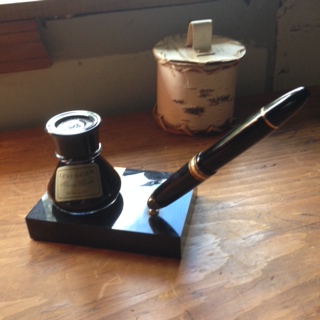
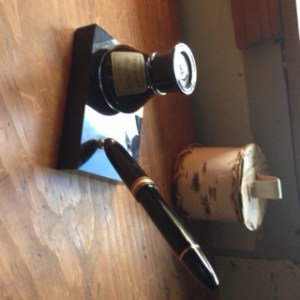
Writing by hand. I call this writing acoustically. When I’m in my Writing Shed, I use a fountain pen—a black fat, elegant pen made by Mont Blanc and left to me by my mentor, Ed Brush. Recently, I have discovered Levenger ink—Raven Black.

My hand-written writing comprises two things: recording the Animal Tarot Cards I draw each day, and my morning pages. I sometimes skip my morning pages. I think that is okay.

As I wrote today, I noticed I was writing legibly, neatly, evenly, taking the time to form each letter, careful to spell words correctly, and punctuate for meaning. The slow flow of the ink filled the white space on the page letter-by-letter, word-by-word, sentence after sentence, paragraph after paragraph. Its clean smell wafted up from the page.

I slowed down. I took the time to smell the ink.

An actor friend wrote on his Facebook page today that he was taking his next step without a plan. His other plans had all fallen through, so he was just moving forward, leaving behind fear of what others thought of him, embracing his own life.

He was writing with ink.

My career path in life has been pretty non-existent. I got diverted from a career in health care administration when I quit a job after ending a relationship with my boss. I became a bar tender so I could spend time with my writing.

That was nearly 40 years ago. That decision was the turning point of my life—the moment I decided to embrace my own life, though I didn’t know it at the time. I backslid off and on, taking paths that had clearly marked signposts. I failed miserably anytime I tried. The signposts annoyed me.

Where Fred Astaire aspired for perfection, Gregory Hines would allow a mistake to take him to the next move, making it up as he went along if the occasion called for it.

He improvised.

It has occurred to me that improvisation, rather than a career, has determined my path in life.

The constant has been writing, though it has only been the last ten or so years that I found my voice.

I love writing on a computer. It allows me to keep pace when my mind is racing. Its fluid nature matches the way my mind writes, then edits. Backspacing letter by letter to erase a word, highlighting whole sentence or paragraphs to cut them, or cut then paste them somewhere else. Seeing the change instantly in black and white without the distraction of crossed out words, scratched out sentences or paragraphs, arrows and notes to indicate where to move a circled word, phrase, sentence, or paragraph.

It has its own flow—writing on a computer.

But writing by hand, with the pen that once belonged to Ed Brush, the flow of ink filling the empty page, the smell of ink transporting me into the moment—that’s an improvisational moment for me.

Much like life, there’s no Undo command when you write by hand. Make a mistake. Then improvise.

The Changing of the Light

I am a little disappointed that Mama Quail left without saying goodbye.

Mama Quail was nowhere to be found the last I saw of the Quail family. Her babies, I think it was they—no longer fuzzy but still a fuzzy brown color—lifted from the ground with a flutter of wings as I started down our long driveway to retrieve our New York Times.

She had taught them well. They recognized an intruder and fluttered away in different directions. If I had been their predator, I would not have known which way to follow.

It is the Autumnal Equinox. Equal day and equal night. Light and dark share the stage equally as our part of the world makes its journey to the Winter Solstice. Dark has dominion during the coming season—staying longer each day until the Solstice, when Light starts its ascent.

The Harvest Moon rose big and bright this week, lighting up the San Juan de Fuca Straits. It’s called the Harvest Moon because in the times before we (we, as in humans) learned how to light the dark with electricity, its brightness extended the day so our food could be harvested into the night.

The beginning of a time of gratitude.

I have always liked the Fall—the way the air cools, the trees adorn themselves with new colors, the light shines through an almost invisible haze. It has always seemed like the beginning to me. Pagans recognize that. It is when they celebrate the end of one year and beginning of the next.

As our home begins this orderly transformation from one season to another, we humans are walking a different path. A mad man uses chemical weapons to slaughter innocents in Syria. Mad men randomly slaughter people going about the mundane motions of their daily lives. Politicians fluff their feathers to appear bigger than they are, threatening world chaos if they don’t get their way.

When God hates the same people you do, you have created God in your own image.

I never know how to answer the question, “Do you believe in God?” I guess it seems like the wrong question to me, as if there are only two answers, “Yes,” or “No.”

It’s not so much I believe in God, as I see there is an orderly transformation from one season to the next. Not orderly in the sense of schedule or chronology or predictability. Orderly in that one season turns into the next. Life begins and Life ends and then a new Life begins. There is pain, there is sorrow, there is joy, there is ecstasy.

If might makes right, there is no room for love in this world.

I don’t think that means being passive. I think it means recognizing that life is more a rock-scissors-paper world than one where owning an assault weapon ensures your safety.

But, what do I know?

I know that today is the Fall Equinox. It is my seventeenth wedding anniversary and we just purchased a home on Happy Valley Road. I will soon be living in Happy Valley where the elk wander through from time to time and the Olympics stand still in the background—a good vantage point to witness the changing of light.

Still. I’m a little disappointed that Mama Quail didn’t stop to say goodbye.

The White Wall

new yard path 1“I wish I’d paid better attention. I didn’t yet think of time as finite. I didn’t fully appreciate the stories she told me until I became adult, and by then I had to make do with snippets pasted together, a film projected on the back of my mind.”
—Jessica Maria Tuccelli, Glow

I want to ask:

“Did he bring me a kitten from the Rub’al Khali?”

“Did you go to Fisk?”

“Did you really take your vibrator to Mr. Fixit in Mill Valley?”

But they are all gone, the people that could answer those questions. I am left with my memory of them.

Years ago, I don’t remember which television news magazine reported it, I saw a story about a woman, an artist, who had received a devastating diagnosis: she had an aneurysm that could burst at any moment and she would die.

She lived with this knowledge for a year. A moment-by-moment experience of life. After a year, they discovered that she had been misdiagnosed.

This is what I remember about her story.

Sometime after that year, a gallery owner came to her studio. He noticed a subtle, but significant difference between her paintings. She told him her story and they realized that the differences he noticed reflected that year of living with the knowledge that life, time for her, was finite. There was a distinct before and after to her work.

He wanted a gallery show that told that story. They decided on a mural that would take up one wall of the gallery. She wanted it to be done with pastels. She wanted it to be up for one month, and one month only. And she wanted the opening to be reserved for people who were living with a terminal diagnosis.

I believe she spent a month on the mural, weeping as she worked, her fingers bleeding from working pastel onto plaster. As I remember the mural, it was a series of framed scenes, scenes as you would see them through a window, as if you were doing something mundane, happened to look up, and a snippet of life, simple but glorious, washed over you.

At the opening, the invited guests passed through slowly, weeping. Weeping with joy and sorrow.

After one month, she stepped back to look at it one more time, then wept again as she took scrub brush in hand and washed away her work of love and passion.

But a ghost of the image remained. The gallery, with her permission, covered it with white paint.

In a way, it was the coat of white paint that touched me the most. Behind it, the ghost of the mural remains.

I have come to think that that is how it is when we die. We disappear behind the coat of white paint, but the ghost of our experience remains—in the memory and hearts of those who experienced us.

I stand with my back to the white wall, its coat of paint between me and the people who are gone. I have memories, some vivid and clear, others misty and muddled. I cannot verify any of them. I cannot point to them as facts. But I trust their presence behind that coat of white paint, and that their presence in my life has shaped it.