You Can’t Get a Man With a Gun

I’m quick on the trigger with targets not much bigger
Than a pin point, I’m number one.
But my score with a feller is lower than a cellar-
Oh you can’t get a man with a gun.

From Annie Get Your Gun, by Irving Berlin
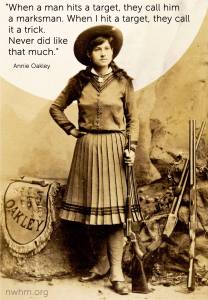
Annie OakleyI was single and lonely in June 1986 when Newsweek hit the newsstands with the cover story “The Marriage Crunch,” which reported that a college-educated woman over 35 had only a 5% chance of getting married and by the time she reached 40 she was more likely to be killed by a terrorist than to marry.

I mean what does a smart woman do with that information?

I remember thinking during the days after 9/11 that instead of color-coding terrorist warnings, that they should use a system of wedding bells. One or two and we were safe. Three or more, take cover because those over-35-year old college educated women were taking us down with their marital bliss.

I thought of this again in light of the near mass hysteria after the rampage in San Bernardino, which was the third mass shooting since the rampage at a Planned Parenthood clinic in Colorado less than a week before.

I am not making light of the fear engendered by these incidents, I just find it interesting that near-mass hysteria arose out of the tragedy in San Bernardino. Terror is terror. Yet, our collective psyche gives weight to the terror inflicted by crazed, religious zealots we have defined as the ”other,” which has come to mean Muslims.

Jews, Christians, and Muslims are descendants of the same father, Abraham, and the God they all look to for meaning. You can find gnarly passage in each traditions’ holy text, so in spite of the likes of Bill Maher, none can claim the high ground when it comes to massacre in the name of that God. It’s sibling rivalry vying for the position of one-who-dad-loves-most.

I think the roots of this can be found in the story of Sarah and Hagar and Abraham. When she could not conceive, Sarah gave her slave Hagar to Abraham to be the surrogate mother. This was apparently fairly common practice back in the day. Hagar bore Ishmael. Years later Sarah bore Isaac. The women became jealous of each other, vying for whose son would be the favored.

Hagar was an Egyptian slave, so was always considered the outsider. The “other” (her name even means Other) always loses. Sarah insisted that Hagar and Ishmael be exiled—sent out into the desert to fare for themselves. They were given a loaf of bread and, as a sign from Abraham that they were under his protection and so should not be killed by the tribe—a small skin of water.

Their exile was pretty much a death sentence in and of itself. The landscape is unforgiving. The water quickly ran out. The story goes that as Hagar watched her son lie dying of thirst, God showed her a miracle, she found water, and they lived.

I try to imagine how a woman could exile another woman and her child to certain death. It was all over whose son would be “king.”

newsweek1Around the time Newsweek was reporting on my fate, I had become friends with an African-American woman (I’ll call her Janet) who had been raised in the south. Her mother was the maid to a Jewish woman. Being Jewish in the south in the Sixties was just slightly safer than being African-American.

In 1965, Janet and the son of her mother’s employer fell in love and she became pregnant. He was killed in a church bombing. She gave birth in the Negro ward. A nurse approached her and asked her to wet nurse a white baby whose mother was having trouble nursing it. I don’t remember the details, but the baby’s life depended on being nursed.

Janet said she had to think about it. I asked her why she had to think about it.

“Because that child could grow up to kill my child,” she said.

“What did you decide?” I asked.

“To nurse him.”

“Why?” I asked.

“My mother told me I had no choice. This was a child.”

The story of Sarah and Hagar is the story of women who derive their power, their status, from men. It was written long ago, in a landscape that was harsh and unforgiving.

I think it’s time to change that story.

Women need to claim their own power, rather than derive it from another source. We have the power to carry and nourish life, whether it is literally by bearing and nourishing a physical child, or metaphorically by recognizing our bodies know inherently what is required to bear and nourish a child, and make choices accordingly for ourselves, our families, the society we live in, and the global community we inhabit.

In a recent New York Times interview, Tina Fey describes the two characters in her new movie “Sisters” as being in conflict, but not competition.

I think that’s how we change the story. Recognize that conflict is not competition, that conflict feeds collaboration and cooperation.

We need to commit to never again sending a woman and her child into the wilderness because we are afraid them, but rather find a way to make room for both their child and ours. To do what my friend Janet did and nurse the child with the hope that a life sustained by love can be a person who grows up to trust love over hate.

The underlying message of the “The Marriage Crunch” was the one I had been given earlier in life: you cannot be an individual and be in a loving relationship.

Kind of what happened to Abraham and Sarah and Hagar.

If you buy that, perhaps those Newsweek statistics were true.

One might say I beat the odds spelled out in 1986. I got married. But really, I met and fell in love with a man who is not afraid of me.

So what does this have to do with Annie Oakley? Maybe nothing, but it was during that time in 1986 when I was single and lonely that I heard the lyrics to “You Can’t Get a Man With a Gun,” from Annie Get Your Gun, a fictionalized account of Annie Oakley.

I’m going from notes here, but apparently the musical ends with Annie purposely losing a shooting match with the man she loves to soothe his ego (You Can’t Get a Man With A Gun). And so they marry. She got her man.

Not who Annie Oakley was (see above).

It’s true you can’t get a man with a gun. It’s also true that putting weapons in the hands of amateurs does not make us safer from crazed people armed to the teeth with weapons of massive destruction. The professionals proved this in the resolution of the San Bernardino massacre.

That was a non-sequitor, but I couldn’t end this post without saying it.

Crossing Water

IMG_0915

Commons Coffeehouse and Bookstore where we met and learned and drank coffee in Langley, Wa on Whidbey Island.

There’s something about crossing water that makes me feel like I’m going someplace different, a place where something will happen.

That’s what I thought as the ferry left Port Townsend on October 6th for Whidbey Island where I had signed up for an Algonkian Writer Conference. It was, I also noted, what would have been my father’s 99th birthday.

My father is who introduced me to travel by water. When I was eight, we got on the Wonosobo, a Dutch freighter, in Dammam, Saudi Arabia, and 75 days later docked in Long Beach, California. The last two weeks, we saw no land as we sailed through typhoons, waves crashing over the top of the ship.

I loved it.

When I was 60, I discovered the letters he had written to my four-year old self when he was alone in Saudi Arabia, yearning for the time we would join him there.

I suspect it is because of my father that I am a writer. As I read his letters, I understood what a good storyteller and writer he was. A man who hadn’t graduated from high school put pen to onion skin paper and described nights in the Empty Quarter shared with desert foxes, kangaroo rats, and men who snatched locust from the air and consumed them with great gusto and trudged to the highest sand dune each sunset where they lay their prayer rugs and bowed and kneeled and bowed and kneeled and touched their heads to the rugs in the presence of Allah.

Perhaps that’s why I thought of him as I rode the ferry to my writers’ conference. A mere 35-minute ride.

This conference was about getting your break-out novel published. I have done little to get published. I have enough rejection letters, emails, and messages posted on my accounts advising me my piece was not accepted to prove I am a writer. What’s a writer without rejection notices?

So what’s a writer who hasn’t been published?

Well, that’s a conundrum for me. I want to be published, to have people read what I have written.

But, I hate the process—think it’s a terrible business model. But it is what it is.

To be perfectly honest, I have resisted that next step in writing—that step where you actually try and get published. I think it is my last self-imposed barrier that keeps me small—keeps me from being seen.

I’m a bit embarrassed about that, but there it is. I’ve said it in public.

I’d like to report that my brilliance was recognized and you can expect that my break out novel is coming to a bookstore near you soon. Oh, right, there aren’t many bookstores. Okay, coming to an online bookstore soon.

But, I cannot report that. I learned what I suspected—getting published is a daunting task. One of the most difficult hurdles is getting past what the conference leader referred to as the “Twenty-two year olds”—the overworked and un- or underpaid interns who are the gatekeepers.

And then there’s the problem that I write literary fiction or what is referred to as up-market fiction. Hard to market it.

I got a great appreciation for what an agent does, the amount of work they have to invest to get you in the door. All on speculation. It is market driven—neither the publisher nor the agent can take great risks on unknown authors, especially if they write what is hard to market.

Sigh.

But, I also learned how to pitch a novel, and got a good template for planning out a novel—which helps one winnow the pitch down to that famous elevator conversation. Oh, and that my writing and my storytelling are solid.

I believe in what I am writing.

So, I got what I needed. Something happened. I have broken down that last self-imposed barrier. I’m not afraid anymore of being seen nor do I need to keep myself small. I’m willing to do the work to get published.

With a little bit of luck, I won’t be that author that they discover posthumously, but one who gets published in her lifetime.

It’s just a matter of continuing to cross water to get to someplace different where something will happen.

It’s kind of being a grown up.

Sigh.

I should add that I met terrific writers, kind, smart, talented—my tribe—and they all live close by. Worth its weight in gold.

Some Say the World Will End in Fire

Our friend’s world ended in fire over the weekend.

Owen Goldsmith and Tom Darter in 1969, before the premiere of Psalm 90.

Owen Goldsmith and Tom Darter in 1969, before the premiere of Psalm 90.

Owen Goldsmith had been Tom’s friend since high school. He was his music teacher, but more, he was Tom’s music mentor.

Owen taught a rigorous music theory class, which Tom took when he was a sophomore. Music theory in high school is really unusual. For a final spring assignment, Owen asked members of the class to write something. When Tom came back with the beginnings of what he has called “a very bad imitation Mozart string quartet,” Owen said, “Well, this is okay, but I wanted you to write something of your own.”

In response, Tom wrote four Sketches for Woodwind Quartet. A year later, it was played at San Jose State University’s Festival of 20th Century Music, in a concert that also included pieces written by Ernst Toch, John Cage, Anton Webern, and Robert Palmer (who later became one of his teachers at Cornell). Tom was 15 when he wrote the piece, and 16 when it was performed. All because of Owen.

During Tom’s first year of college, a dorm fire took the lives of four students. Psalm 90 was read at their memorial. Tom was so moved by it, he set it to music and dedicated it to Owen and the Livermore High School a cappella choir, which was conducted by Owen. Their 1969 performance of it is flawless. College choirs have hesitated to take it on because it is too complicated.

And their performance is flawless. Listen to it here.

To say that we were blessed with the teachers we had in Livermore during the 60s doesn’t really do it justice. We were more than blessed.

Ed Brush. Art Duey. Claude Cameron. Judy Beery. Jack Beery. Ernie Dust. Roland Carlson. Bert Fraser.

To name just a few.

You know how you don’t teach people what to think, but to think? Well that’s what they did. And more.

There was a synergy to those years. They taught art, music, literature, history, math, and, science as living, breathing beings. I first read Faulkner’s Nobel Prize speech in Bert Fraser’s English Honors class my senior year. I have returned to it often over the years, divining new meaning from it each time I read it.

When a group of us, high school and college students, formed a theater company called Auxiliary Players, they gave us their encouragement, came to the performances, participated in some.

One of our earliest performances included one-act plays by Eugene O’Neill, Tennessee Williams, and Harold Pinter. Three very depressing plays.

As he was walking out of the theater at the end of the performance Tom asked Owen what he thought. “I’m going to go home and read Who’s Afraid of Virginia Woolf to cheer up,” he replied.

They let us fail. Acknowledged our failures. And we learned from them. Our next performance had much better rounded programming.

Tom and I stayed friends with Owen. He was part of out Thanksgivings, came to our wedding. We visited him in his home in Mountain Ranch where we sat on his deck and drank in the quiet beauty of the Sierra foothills. In his letters to us he wrote of the wildlife that visited his property. We talked to him often and called him every year on his birthday, October 8th.

Our most recent phone call with him was three or four weeks ago. It was clear that Owen was failing. He was having mobility problems. He was depressed, and his depression fogged his mind.

We worried when we heard that the Butte fire was heading his way. His family filed a missing persons report. Then yesterday we learned that his remains were found in the ruins of his home.

Owen would have been 83 this October. A phone call we will miss.

We will probably never know why he didn’t get out—why he didn’t evacuate. I personally think it was a conscious decision on his part not to leave. I don’t think he could have recovered from the devastating loss of his beloved home and the beauty that surrounded it. I suspect he had already died when the fire consumed him.

I have thought of Robert Frost’s poem “Fire and Ice” since we started worrying and wondering about Owen. It’s a tribute to my high school teachers that I would turn to poetry and remember a specific poem at such a defining moment. It’s not so much it gives me solace, as it gives me a place to go when life becomes unfathomable.

Fire and Ice
By Robert Frost

Some say the world will end in fire,
Some say in ice.
From what I’ve tasted of desire
I hold with those who favor fire.
But if it had to perish twice,
I think I know enough of hate
To say that for destruction ice
Is also great
And would suffice.

Turn Left at the Whale

DSCN1057I have been on blog silence for three months. I know. I know. You’re not supposed to go on blog silence, but since my whole intent with starting Writing Shed was to change my story, I’m giving myself permission to make my own rules.

I go silent when I don’t know what to say.

These past three months have not been easy ones. Tom started radiation in July. Each treatment lasts 10 minutes and we are about 10 minutes away from the facility. So treatment and round trip amount to about 30 minutes a day, five days a week. He has 10 more treatments.

Doesn’t sound like much—30 minutes a day. Radiation doesn’t have the noxious effects (they aren’t side effects, they are effects) of chemotherapy. And yet, it has been a period of endurance for him. I am on the sidelines watching it. Helpless to do anything to make it more endurable as he prepares five days a week to do what he can to protect his bladder and bowel from the noxious effects of radiation.

Every Monday he meets with the radiation oncologist where he is asked questions to determine if he is being affected by the treatments. Any trouble urinating? Any pain urinating? Any diarrhea? Any fatigue?

No. No. No. And yes. Being hyper-aware of one’s bodily functions is exhausting.

There was something sobering about Tom starting the treatments. It made his diagnosis real. And then two weeks ago, we learned that it will be about a year and a half before we find out if the treatments are indeed curative. Six-month intervals of PSA tests. And even then . . .

That’s the reality of a cancer diagnosis. Once it enters into your home, it’s there as a ghost—if not an actual presence.

It’s the new normal—the realization that there is an end parenthesis, even if it isn’t punctuated with cancer. One never knows when it will come or how it will come or if it is your end parenthesis or an end parenthesis that leaves you the one left behind.

We all have that end parenthesis hanging out there. It’s just that it’s a bit more in our faces.

The new normal.

For me, it has made me wonder, why did I, a native Californian, end up in the Pacific Northwest for this journey into the wilderness?

The theatre group we threw ourselves into turned out not to be our tribe. It tends towards the cliquish, and Tom and I are the opposite of that. We didn’t fit. It was a loss on many levels, including losing a feeling of belonging. His diagnosis intensified our feeling of loss and isolation.

So why here? Why now? What?

Turn left at the whale.

That was the instruction I received to locate the Marketing Your Small Business class offered by the Jamestwon S’Klallam Tribal Library. The photo at the top of this post is the whale at which I turned left.

The culture that was here before Europeans arrived, the Jamestown S’Klallam Tribe, is strong here. I want to say that their artwork is pervasive, but I think referring to it as artwork doesn’t quite fit. It is a work of being, rather than something that is done.

In June, a totem pole that tells the story of why the sun shines in Sequim was installed in the new Civic Center plaza. I had stopped by the House of Myth where the carvers were working on the totem pole so had seen it as it transformed from a piece of wood into a story.

The dedication included a ceremony conducted by the tribe.

Last night, I attended a storytelling event that featured Tribal Elder and Storyteller, Elaine Grinnell, who shared stories of her people, the Jamestown S’Klallam, the Strong People. The blurb that described the event said that her stories can, “. . . include retellings of canoe journeys in the wild North Pacific Ocean, where death is always a possibility that must be faced . . .”

As I listened to her last night, the answer to the questions, why here, why now, and what washed over me.

Turn left at the whale.

I live in a place that is a reminder of being. A place where the original inhabitants derived their spiritual essence from the environment that surrounds them—who recognize that the end parenthesis is a part of being.

The new normal that was actually the normal all along. It just comes with eyes that see more clearly, ears that hear more perceptively, and a heart that feels more strongly.

Turn left at the whale to discover your human being.

I cannot leave this post without thanking Renee Emiko Brock-Richmond, who taught the class, for her gracious and generous spirit. Check out her website.

Now What?

I had one of those dreams this morning—the kind you have after you wake and think your day is starting, but then you fall back to sleep.

I encountered a young deer, a buck, on a trail. I tried to let him pass, stood very still, but he reared back and placed his front legs against me. I tried to make myself seem even more still. He placed his cool, black nose against mine. I realized he wasn’t threatening me or threatened by me.

I woke with a vivid memory of the deer.

So I did what I do when I have interesting encounters with animals, I looked up its meaning in the Animal-Wise Tarot book. Mythologies are ripe, it says, with tales of heroes being lured into new, transforming adventures by chasing the deer. Lured from civilization back into the wilderness by the hunt.

The new “normal” is setting in for Tom and me. Tessa Dog continues to be an absence that is a presence. But her absence is part of the new normal as we prepare for his next course of treatment—radiation.

Radiation disrupts both cancer cells and healthy cells. Cancer cells, the invaders, are not as good at repairing themselves as are healthy cells, the legitimate residents in our bodies. Antioxidants are good for us because they help repair our cells—but apparently help cancer cells as well. And so antioxidants aren’t recommended during the 9 weeks of radiation therapy.

Whatever that means. Antioxidants are part of the food we eat as well as supplements like vitamins C, D, and E. Are all antioxidants created equal?

Though I appreciate the radiation oncologist’s knowledge about the physics of radiation, he wasn’t really very helpful when it came to information about antioxidants. He also didn’t seem interested in learning anything about them. I was left with the feeling that we are at the mercy of cancer and radiation—neither of which is known for merciful behavior.

This is a limitation to the science of medicine. I highly respect the science, but the art needs to come in as well. That means engaging the patient. I’m sure we will find a way to work through this, as Tom is working with a naturopath as well.

So maybe that is the wilderness we are being lured into—a forced engagement with ourselves—each in our own way. A deep plunge into life, what it means to us, and our agency over our own lives.

The wilderness for me, the fears it evokes, are of having my head chopped off if I rise above. Or being the nail that gets banged down because it sticks up. Or being a flower that is taller than the others.

Being that which makes me one of a kind.

In my heart of hearts, I believe that we are all one of a kind, creating the story that comes out of our experience of life. The joys and the sorrows. The triumphs and the failures. The loves and the losses.

Compassion for being human is at the core of it. Especially compassion for ourselves.

We are reaching the two-year anniversary of moving to the Northwest. I often think I’m still in California because we are still on the left coast. But it has been a significant change. One sees evidence up here, for example, of the original inhabitants. Tribal centers. Towns with native names. Totem poles carved for civic centers.

There is a feral quality that transcends here.

I’m not even sure where I’m going with this except to come back to my title: Now what?

Tom has said that he thinks cancer is outnumbered. I think that’s true. But as much a part of this that I am, when it comes down to it, this is Tom’s battle to wage. I am on the sidelines.

I feel like that candle in the wind Elton John wrote of.

I’ve been searching for my armor, my protection from the fears evoked in my wilderness. I think the deer in my dream was telling me that armor isn’t the answer. Protection isn’t the answer.

Valuing my experience of life is.

It occurred to me recently that no one has the right to survive. We are all at the mercy of life’s randomness. We can be in the wrong place at the wrong time, or the right place. Over that we have little, if any control.

But we do have a right to our life, to embrace its story, to dive into the experience of it.

So, I guess the answer to my title, “Now What?”, is to follow the deer into the wilderness and see where he leads me.