The Mystic Chords of Memory

I’m a miserable failure at nanowrimo. By today, I should have written 8000 words. But four days into nanowrimo I have no idea how many words I have written, but it doesn’t even come close to 8000.

happy frog

Frog reacting to the number of words I have written for nanowrimo

I settled yesterday for taking Ernest Hemingway’s advice: write until you’re ready to write tomorrow. That’s where I ended up yesterday; with a character showing up in a way I didn’t expect. And now I have to listen to him to find out why he did that.

That’s what will move the story forward for me.

I have tremendous respect for anyone who can do nanowrimo. I don’t have a clue how they can.

But here’s what committing to nanowrimo did for me: it got me to commit to commit.

I haven’t blogged for a while. As those of you who have been following my blog might know, I have spent the last several months rewriting my story. Not the one that will be published, but the story that I want to live.

autumn light2I had a flurry of blogs during that time. Epiphany followed epiphany; it was easy to write. But epiphanies fall all over themselves during a time of change. Eventually, things calm down. Change happens, and daily life becomes more – well daily. That means that the change has taken effect – and it’s time to integrate it.

For me, that means start living the new story.

I heard the phrase “mystic chords of memory,” as “mystic cords of memory.” Thought that it meant the things that hold you to your past – as if they were tentacles. But chords are much different. They do not hold you to your past so much as give it texture. path autumn light

When I hear Crosby, Stills, and Nash I am transported to the place in myself that felt the music when I first heard it close to forty years ago.

When I hear Mahler’s second (I’m listening to it now), I just get transported to a timeless experience of being human, of being resurrected after a period of loss and grief.

Resurrection is a difficult time for me. To rewrite my story, I had to experience a lot of grief. Grief over loss of what I hoped would be; grief over the death of parents and friends; grief over losing family members who were not willing to be with me in my new story, even though the old one was destructive for me. We want to think that family wants the best for us, but sometimes what family wants is for things to stay the same, for everyone to keep their place, regardless of the damage it may cause the spirit.
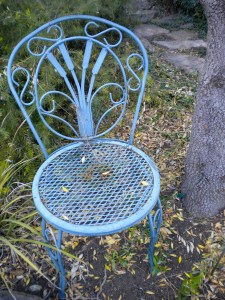
chairSuch can be the price of change – learning that those you love, might not have a heart large enough to include you.

As painful as grief is, what is equally hard for me is being willing to step back into my life knowing that I will no doubt experience grief again. Knowing that loss is a part of life and that I have to be willing to grab hold as if life will last forever, and then let go when life shows me that its definition of forever is more subtle than mine.

And so, yesterday, when I realized that I was not going to come close to meeting the goals of nanowrimo, I had to look at what I was doing with my new story. Writing it isn’t enough. I have to live it now.

I said I was a miserable failure at nanowrimo. I actually think I’m a cheerful failure at it. I probably won’t reach the 50,000 word goal this month. But, I am using nanowrimo to focus. Focus on getting the first draft of my novel done.

And that is how I am living my new story. I’m committing to committing. I’m committing to letting go of the mystic cords of memory that tethered me to my past, and instead paying attention to the mystic chords of memory – knowing that they provide texture to my life, and that by letting go, the better angels of my nature will touch those chords – and from them will arise a chorus as life-affirming as that in Mahler’s resurrection symphony.

Note: The reference to mystic chords of memory comes from the last paragraph of Lincoln’s second inaugural address: “I am loath to close. We are not enemies, but friends. We must not be enemies. Though passion may have strained, it must not break our bonds of affection. The mystic chords of memory, stretching from every battlefield and patriot grave to every living heart and hearthstone all over this broad land, will yet swell the chorus of the Union, when again touched, as surely they will, by the better angels of our nature.”

Rush Limbaugh, Glenn Beck, and Sarah Palin – pay attention.

And for you who are up to the task – Go nanowrimoers, go!

Imagining with a Big Heart

DSCN0184I said in my last blog that there would be more.

More about the Wild Woman.

More about giving up all hope that there is room for me in the landscape imagined with a tiny heart.

So now my job is to imagine my own landscape. A landscape imagined with a big heart.

I watched Across the Universe the other night. The Julie Taymor film that uses Beatles songs to tell the story of an era. Boy, does Julie Taymor imagine with a big heart.

One of the most poignant scenes is the one she imagined for the song “Let it Be”. It is sung as a gospel over images of the Detroit riots, the funeral of a soldier (no older than 19) killed in Vietnam, and the funeral of a young boy (no older than 12 or 13) who was killed in the Detroit riots.

There will be an answer. Let it be.

The special features includes the audition of the woman who sings “Let it Be” in the film. Julie tells her to just put all the rage and pain over what happened in that era into the song and let loose.

And she does.

There will be an answer.

Let it be.

She finishes singing. Members of the crew are speechless – no – wordless.

Seeking words of wisdom, let it be.

Julie goes to her, gathers her in her arms, and holds her as she sobs.

Let it be.

So in my landscape imagined with a big heart, hope that things will change is replaced with faith that there will be an answer. It is home for the Wild Woman.

Let it be.

Thriving With a Big Heart

When seeking guidance, don’t ever listen to the tiny-hearted.
Clarissa Pinkola Estés in Women Who Run With the Wolves

“If you’ve ever been called defiant, incorrigible, forward, cunning, insurgent, unruly, rebellious,” writes Clarissa Pinkola Estés in Women Who Run With the Wolves, “you’re on the right track. Wild Woman is close by.”

Phew.

Wild Woman is close by.

I’ve been excavating lately, as part of rewriting my life story, looking in the nooks and crannies of my psyche to find the noxious notions that rob my spirit of its nourishment the way a tumor steals nourishment away from the body.

I’m rewriting my story so that thriving is the theme, not surviving. I’ve been an excellent survivor my whole life. There is definitely a certain kind of toughness you get from surviving, but toughness is just for getting you through the thorns.

DSCN0162Thriving is what happens when you get past the thorns. The place where the Wild Woman dances an ecstatic dance in celebration of being alive.
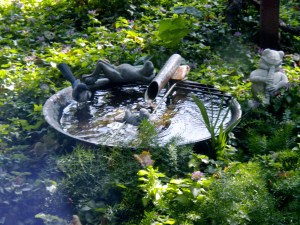
I mentioned a few blogs back that a tree in our yard had died. At the same time, I noticed that the birds weren’t singing in the morning. I was afraid that birds had abandoned me.

Then this morning, before I headed out to my Writing Shed, the yard was filled with birds, including a kind I don’t think I’d ever seen before. As I watched from the window, they feasted on the grapes hanging from the arbor and bathed in the fountain. DSCN0168

I’ve always thought of Fall as the beginning of the year. I wondered if that’s what this was about. Are the birds returning because it’s the beginning of a new year? Or have they been here and I haven’t noticed them?

Whatever, stopping to watch the birds be birds brought me a much needed sense of calm.

For the past few days, I’ve been making my way through the emotional fallout from an epiphany I woke up to on Monday morning. The epiphany being: I believe there is enough (talent, love, life) to go around; I live in a local culture that is terrified that there isn’t enough – so terrified that even the possibility of there being enough is terrifying.

That’s what keeps a heart tiny. Fear that there isn’t enough. It inhibits grace and generosity and enables solipsism.

That’s why one should not seek advice from the tiny hearted.

What’s the emotional fallout from the epiphany? Letting go of being able to change the landscape. Giving up all hope that I can fit in with a tribe whose bond is based on the agreement to keep the heart tiny.

It’s a bit scary to give up that hope.

Fortunately, Wild Woman is close by.

More to follow . . .
_____________________________________________________________

Dragons Never Fear to Tread

I was quite pleased with my post yesterday, where I waxed poetic about slaying my dragon. Then my friend Jim pointed out that dragons have a different meaning in Eastern mythologies. They represent raw power.

I was annoyed with him for disturbing my moment of satisfaction with having slain my dragon. Jim often annoys me because he forces me (okay no one forces anyone to do anything) to dig deeper with his well-maybe-not style of questioning.

I want to dismiss these questions by assigning them to the cynicism bin – where they are sent to be disposed of with no regard for what they might mean to me. I think cynicism is the flip side of a coin that has cynicism on one side and sentimentality on the other. Cynicism annoys me because it, in my opinion, dismisses things by assigning them to bins where they are sent to be disposed of with no regard for what they might mean to the cynic.

I hate when I impale myself on my own prejudices.

So, today I did a bit more googling about dragons and found this interesting link to a site called Dragon Tango. It’s about a sound sculpture that depicts Eastern and Western dragons meeting. Here’s from the Website:

During a trip to Asia in 1994 Amanta and David were in Hong Kong gazing out over the mountains of Kowloon. Kowloon means “nine dragons”. Their thoughts came to rest upon the contradictory and mysterious nature of dragons worldwide. Amanta and David wondered: what does the dragon mean in today’s world? What would happen if an eastern dragon met a western dragon? The dragon quest began.

Dragon Tango

Check out the link. It’s very interesting.

Then I remembered the movie “Dragonheart.” The story tells the tale of the last dragon joining with a disillusioned dragon-slaying knight to stop an evil king who was granted the potential to be immortal. I love this movie. For one thing, Sean Connery is the voice of the dragon and, of course, a dragon would sound like Sean Connery. That is embedded deep in our DNA, probably from the time we lived in caves.

And, I loved it because of how sympathetic the dragon was.

So, I still trust what I wrote yesterday. But maybe there is more.

I think what I was trying to get to is change and how we deal with it. I’ve heard people laugh that horses are so stupid they run into a burning barn. But they do that because that has been their home—what is familiar to them.

And, oh my, if we humans don’t go running into the burning barn time after time. We seek the familiar, even when the familiar is not good for us (think bad relationship number four), because it is comfortable. We know what to expect. We know that story. We suck it up and ignore whatever pain that story might be causing us because it no longer fits—like a pair of shoes we have outgrown.

I think we rarely move easily into change. I think we are usually catapulted into it by life events and for me, it usually means facing the dragon’s breath and letting its fire burn away what is no longer useful. I don’t go willingly into change.

I think that the point of facing the dragon is to show a willingness to be transformed by change. And that slaying the dragon with compassion (if that is the mythic image one is using at the moment) means understanding that the dragon is sacrificing itself so change can happen, much as we die because—well, there just isn’t enough room on the planet for us to be immortal.

I just became the dramaturge for the play “Metamorphoses” at Los Positas. It is a wonderful play. It includes this line of dialogue:

“Transform me entirely, let me step out of my own heart.”

So I must thank my friend Jim for annoying me—making me feel discomfort. I suspect he will annoy me again.

I have known Jim for close to fifty years. His mother was my mother’s best friend. I know she misses my mother. The downside of living a long time is you live long enough to miss your loved ones.

What I Want to Say

The first assignment in my Literary Hybrid class at last year’s Iowa Summer Writing Festival was to write a list that responds to the question, “What do you want to say?”

I wrote down favorite product instructions (and, yes, they really are product instructions):

For best results use joy.

Let go before you think you should.

And then Isabelle Allende’s comment that experience is what you get right after you need it.

Which led to . . .

I’m approaching 60—the age, not the speed limit—and it’s making me think. More like churn. About my life. And what it means to be alive. And what it means to be authentic.

Even if I live to 106, like my great grandfather.

Or 99, like my grandmother.

Or 83, like my mother.

For best results use joy.

Let go before you think you should.

Experience is something you get right after you need it.

That’s what I want to say today.

What do you want to say today?